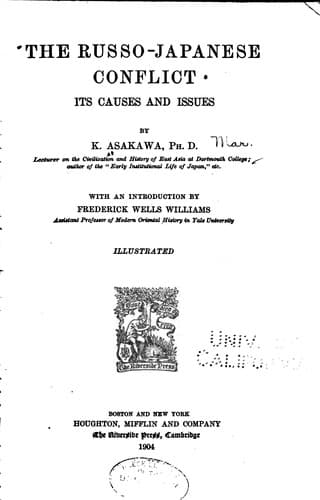
The Russo-Japanese Conflict: Its Causes and IssuesAsakawa, Kan'ichi
History
The Russo-Japanese Conflict: Its Causes and Issues
Asakawa, Kan'ichi
Russo-Japanese War, 1904-1905; Russo-Japanese War, 1904-1905 -- Causes
The _Evening Post_, March 20, 1902; _Tokushu Jōyaku_, pp. 415–416.
Footnote 408:
The _Kokumin_, March 23, 1902.
Footnote 409:
See, for instance, _Ministère des Affaires Étrangères, Documents
Diplomatiques: Chine, 1894–8_, No. 19 (p. 12); No. 36 (p. 29); No. 37
(p. 30); No. 61 (pp. 45–46); No. 65 (p. 49).
Footnote 410:
During the peace negotiations at Peking after the Boxer war, Russia
and France coöperated as closely as did Great Britain, Japan, and the
United States.
Footnote 411:
See pp. 77 ff., above.
CHAPTER XIII
THE CONVENTION OF EVACUATION
It will be remembered that we left the Russo-Chinese negotiation
regarding Manchuria at the point where Prince Ching, either late in
February or early in March, presented a counter-proposal to the Russian
demands.[412] It has also been shown that the Anglo-Japanese Agreement
closely preceded, and the Franco-Russian Declaration followed, this
event. By that time the allied forces had gradually retired from North
China, and the Chinese Court, which had fled to Si-ngan, had retraced
its steps to Peking, arriving at the palace on January 7, 1902. The
political surroundings of the East seemed to have assumed a somewhat
more reassuring outlook, except in Manchuria, than they had worn at any
time since the siege of the Legations in 1900. The Russian Government
seized this opportunity to conclude with China, on April 8, 1902, along
the line suggested by the counter-draft of Prince Ching, the now
celebrated Convention providing for the evacuation of Manchuria, which
went into effect simultaneously with its signature. We subjoin this
important document,[413] together with the official statement with which
the former was published in the St. Petersburg _Messager Officiel_ of
April 12:—
“The grave internal disorders which suddenly broke out over the
whole of China in the year 1900, exposing the Imperial Mission and
Russian subjects to danger, obliged Russia to take decided measures
to protect her Imperial interests. With this object in view, the
Imperial Government, as is already known, dispatched a considerable
military force to Peking, which had been abandoned by the Emperor
and the Government authorities, and introduced a Russian army into
the frontier State of Manchuria, to which the disorders in the
Province of Pechili had quickly spread, and were manifested by an
attack upon the Russian frontier by the native chiefs and army,
accompanied by a formal declaration of war on Russia by the local
Chinese authorities.
“Nevertheless, the Imperial Government informed the Government of
the Emperor that Russia, in undertaking these measures, had no
hostile intentions toward China, whose independence and integrity
were the foundation of Russian policy in the Far East.
Public-domain text, read in full here on John Shaqi.
Reviews
Reviews
No reviews yet
Be the first to share your thoughts on this work.
Elsewhere in the archive
Join the Discussion
Join the discussion
Sign in to leave a comment or review.
Sign InorCreate an account