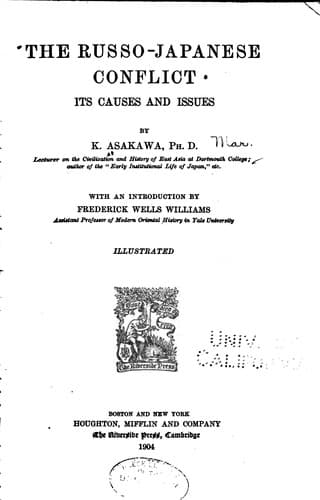
The Russo-Japanese Conflict: Its Causes and IssuesAsakawa, Kan'ichi
History
The Russo-Japanese Conflict: Its Causes and Issues
Asakawa, Kan'ichi
Russo-Japanese War, 1904-1905; Russo-Japanese War, 1904-1905 -- Causes
“ARTICLE 3. In view of the necessity of preventing in the future any
recurrence of the disorders of last year, in which Chinese troops
stationed on the Manchurian frontier also took part, the Imperial
Russian and Chinese Governments shall undertake to instruct the
Russian military authorities and the Tsiang-Tsungs, mutually to come
to an agreement respecting the numbers and the disposition of the
Chinese forces until the Russian forces shall have been withdrawn.
At the same time the Chinese Government binds itself to organize no
other forces over and above those decided upon by the Russian
military authorities and the Tsiang-Tsungs as sufficient to suppress
brigandage and pacify the country.
“After the complete evacuation of Manchuria by Russian troops, the
Chinese Government shall have the right to increase or diminish the
number of its troops in Manchuria, but of this must duly notify the
Russian Government, as it is natural that the maintenance in the
above-mentioned district of an over large number of troops must
necessarily lead to a reinforcement of the Russian military force in
the neighboring districts, and thus would bring about an increase of
expenditure on military requirements undesirable for both States.
“For police service and maintenance of internal order in the
districts outside those parts allotted to the Eastern Chinese
Railway Company, a police guard, under the local Governors
(‘Tsiang-Tsungs’), consisting of cavalry and infantry, shall be
organized exclusively of subjects of His Majesty the Emperor of
China.
“ARTICLE 4. The Russian Government agrees to restore to the owners
the Railway Shan-hai-kwan-Niu-chwang-Sinminting, which, since the
end of September, 1900, has been occupied and guarded by Russian
troops. In view of this, the Government of His Majesty the Emperor
of China binds itself:—
“1. In case protection of the above-mentioned line should be
necessary, that obligation shall fall exclusively on the Chinese
Government, which shall not invite other Powers to participate in
its protection, construction, or working, nor allow other Powers to
occupy the territory evacuated by the Russians.
“2. The completion and working of the above-mentioned line shall be
conducted in strict accordance with the Agreement between Russia and
England of the 16th April, 1899, and the Agreement with the private
Corporation respecting the loan for the construction of the line.
And furthermore, the corporation shall observe its obligations not
to enter into possession of, or in any way to administer, the
Shan-hai-kwan-Niu-chwang-Sinminting line.
Public-domain text, read in full here on John Shaqi.
Reviews
Reviews
No reviews yet
Be the first to share your thoughts on this work.
Elsewhere in the archive
Join the Discussion
Join the discussion
Sign in to leave a comment or review.
Sign InorCreate an account