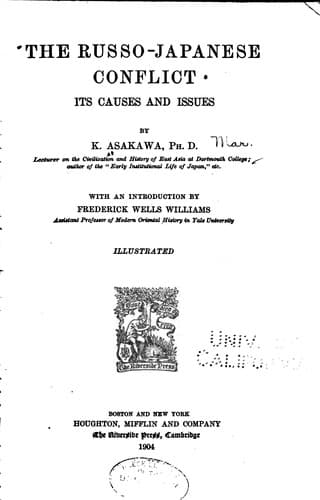
The Russo-Japanese Conflict: Its Causes and IssuesAsakawa, Kan'ichi
History
The Russo-Japanese Conflict: Its Causes and Issues
Asakawa, Kan'ichi
Russo-Japanese War, 1904-1905; Russo-Japanese War, 1904-1905 -- Causes
So far as the immediate interests of foreign nations, aside from the
general principle of the integrity of the Chinese Empire, were
concerned, nothing was more to be desired than a speedy evacuation of
the treaty port of Niu-chwang, where the Russians had maintained a
provisional government since August 5, 1900.[439] At the conclusion of
the Agreement of April, 1901, M. Lessar delivered a _note verbale_ to
the Chinese Government, stating that Niu-chwang would be restored as
soon as the Powers terminated their administration of Tien-tsin, and
that, if the latter event did not take place before October 8, then
Niu-chwang would be surrendered to China in the first or second month
after that date.[440] The rendition of Tien-tsin was accomplished by the
Powers on August 15, but the restoration of Niu-chwang not only did not
follow it, but seemed to be indefinitely delayed for the trivial reasons
presented one after another by the Russian authorities: that, for
instance, one or two foreign gunboats were present in the harbor;[441]
that the Chinese had refused to agree to the constitution of a sanitary
board;[442] and that the Chinese Tao-tai detailed to receive back the
civil government of the port had not arrived from Mukden, where, it has
been discovered, he had been detained by the Russians much against his
will.[443] Up to the present time, the maritime customs dues at this
important trade port have been paid to the Russo-Chinese Bank, and, for
a large sum thus received, the Bank is said to have paid to the Chinese
authorities neither the amount nor the interest.[444]
-----
Footnote 429:
_China, No. 2 (1904)_, No. 65, inclosure 2.
Footnote 430:
_Ibid._, No. 66, inclosure.
Footnote 431:
The _Tō-A Dōbun-kwai Hōkoku_, No. 38 (January, 1903), pp. 105–106.
Footnote 432:
E. g., 400 men from (probably) Shan-hai-kwan, June 24.—_China, No. 2
(1904)_, No. 58, inclosure. Also some from Liao-yang, in
August.—_Ibid._, No. 61, inclosure.
Footnote 433:
E. g., from Kin-chou-Fu early in September.—_Ibid._, No. 62,
inclosure.
Footnote 434:
Cf. Dr. Morrison’s articles in _The Times_, January 3 (p. 8) and 14
(p. 5), 1903.
Footnote 435:
_China, No. 2 (1904)_, No. 56, inclosure (Hosie to Satow).
Footnote 436:
_Ibid._, No. 63, inclosure (Hosie to Satow, September 9).
Footnote 437:
Cf. _ibid._, No. 61, inclosure (Hosie to Satow, August 21), which
says: “I have the honor to report that a considerable town, to consist
of some 300 cottages, of which about 100 have already been built, is
in course of construction on both sides of the Russian railway to the
immediate northwest of the city of Liao-yang Chou. These cottages,
which when completed will occupy a large piece of land bought from the
Chinese proprietors by the Railway Company, are intended for the
residence of railway employees and of the artisans who will be engaged
at the cleaning and repairing shops to be established at this
important depot.
Public-domain text, read in full here on John Shaqi.
Reviews
Reviews
No reviews yet
Be the first to share your thoughts on this work.
Elsewhere in the archive
Join the Discussion
Join the discussion
Sign in to leave a comment or review.
Sign InorCreate an account