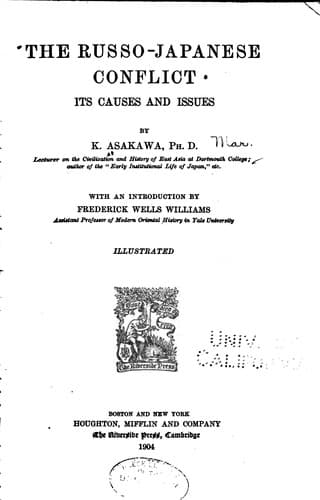
The Russo-Japanese Conflict: Its Causes and IssuesAsakawa, Kan'ichi
History
The Russo-Japanese Conflict: Its Causes and Issues
Asakawa, Kan'ichi
Russo-Japanese War, 1904-1905; Russo-Japanese War, 1904-1905 -- Causes
“While this foreign town is growing outside, the Chinese Government
buildings inside the city of Liao-yang are being rapidly evacuated, in
many cases the only vestige of the Russian occupation being a solitary
sentry keeping guard over the property. Russian troops are also being
withdrawn from Liao-yang and conveyed by rail to Port Arthur.”
A more direct testimony came from the Russian diplomats, probably M.
Lessar himself, who, even so late as at the beginning of September,
1903, or a month before the end of the stipulated period for the
complete evacuation of Manchuria, intimated to Prince Ching that the
reason for the delay of the actual evacuation was “that the barracks
for the railway guards were not ready.”—_China, No. 2 (1904)_, No.
156.
Footnote 438:
The _Novoe Vremya_ itself declared toward the end of the year 1902
that, contrary to the popular notion that Russia was evacuating
Manchuria, she was just beginning to consolidate her influence in that
region.
As regards the number of the Russian troops left in Manchuria after
the first period of evacuation, we have the following authoritative
statement by Count Cassini, Russian Ambassador to the United States:
“Faithfully adhering to the terms of her treaty with China respecting
Manchuria, she [Russia] had withdrawn the major portion of her troops
from that province until _between 60,000 and 70,000_ only
remained.”—The _North American Review_ for May, 1904, pp. 682–683. It
is not clear whether this number included the Russian soldiers
stationed outside of the Chinese quarters.
Footnote 439:
See pp. 144–145, above.
Footnote 440:
_China, No. 2 (1904)_, pp. 38 and 42.
Footnote 441:
_Ibid._, Nos. 72, 74, 75, 111, 112.
Footnote 442:
_Ibid._, Nos. 131, 132.
Footnote 443:
_Ibid._, Nos. 70, 122, 130, 131.
Footnote 444:
The _Kokumin_, May 30, 1904; a Peking correspondence. Also see _China,
No. 2 (1904)_, Nos. 44, 46–48, 69, 73, 96, 99, 102, 105, 124.
CHAPTER XV
DEMANDS IN SEVEN ARTICLES
Public-domain text, read in full here on John Shaqi.
Reviews
Reviews
No reviews yet
Be the first to share your thoughts on this work.
Elsewhere in the archive
Join the Discussion
Join the discussion
Sign in to leave a comment or review.
Sign InorCreate an account