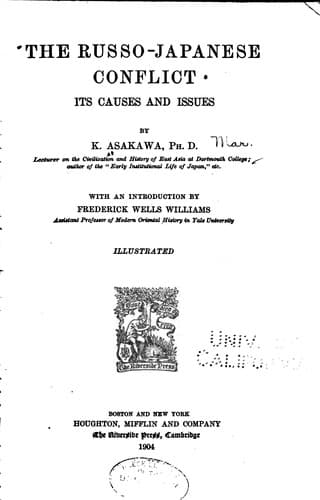
The Russo-Japanese Conflict: Its Causes and IssuesAsakawa, Kan'ichi
History
The Russo-Japanese Conflict: Its Causes and Issues
Asakawa, Kan'ichi
Russo-Japanese War, 1904-1905; Russo-Japanese War, 1904-1905 -- Causes
7000 troops in the Kirin and Hei-lung Provinces for another year.[461]
Long before September, however, it had become apparent that the delay in
the second part of the Manchurian evacuation was due to no casual event.
The appointed time-limit, the 8th of April, had hardly been twenty days
past, with no signs indicative of a possible speedy withdrawal, when new
demands in seven articles of an highly exclusive nature, which the
Russian _Chargé d’Affaires_ had lodged at the Foreign Office of
Peking,[462] leaked out,[463] were confirmed by Prince Ching,[464] and
spread broadcast over the astonished world. Further evacuation was
probably implied, if not declared, to be dependent upon the acceptance
of these demands,[465] the most authentic version[466] of which is here
subjoined:—
“1. No portion of territory restored to China by Russia, especially
at Niu-chwang and in the valley of Liao-ho, shall be leased or sold
to any other Power under any circumstances; if such sale or lease to
another Power be concluded, Russia will take decisive steps in order
to safeguard her own interests, as she considers such sale or lease
to be a menace to her.
“2. The system of government actually existing throughout Mongolia
shall not be altered, as such alteration will tend to produce a
regrettable state of affairs, such as the uprising of the people and
the disturbances along the Russian frontier; the utmost precaution
shall be taken in that direction.
“3. China shall engage herself not to open, of her own accord, new
ports or towns in Manchuria, without giving previous notice to the
Russian Government, nor shall she permit foreign consuls to reside
in those towns or ports.
“4. The authority of foreigners who may be engaged by China for the
administration of any affairs whatever, shall not be permitted to
extend over any affairs in Northern Provinces (including Chili),
where Russia has the predominant interests.
“In case China desires to engage foreigners for the administration
of affairs in Northern Provinces, special offices shall be
established for the control of Russians: for instance, no authority
over the mining affairs of Mongolia and Manchuria shall be given to
foreigners who may be engaged by China for the administration of
mining affairs; such authority shall be left entirely in the hands
of Russian experts.
“5. As long as there exists a telegraph line at Niu-chwang and Port
Arthur, the Niu-chwang-Peking line shall be maintained, as the
telegraph line at Niu-chwang and Port Arthur and throughout
Sheng-king Province is under Russian control, and its connection
with her line on the Chinese telegraph poles at Niu-chwang, Port
Arthur, and Peking is of the utmost importance.
“6. After restoring Niu-chwang to the Chinese local authorities, the
customs receipts there shall, as at present, be deposited with the
Russo-Chinese Bank.
Public-domain text, read in full here on John Shaqi.
Reviews
Reviews
No reviews yet
Be the first to share your thoughts on this work.
Elsewhere in the archive
Join the Discussion
Join the discussion
Sign in to leave a comment or review.
Sign InorCreate an account