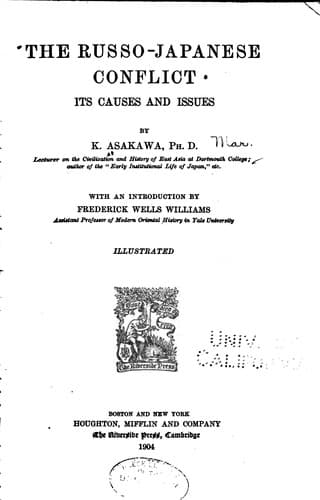
The Russo-Japanese Conflict: Its Causes and IssuesAsakawa, Kan'ichi
History
The Russo-Japanese Conflict: Its Causes and Issues
Asakawa, Kan'ichi
Russo-Japanese War, 1904-1905; Russo-Japanese War, 1904-1905 -- Causes
The most important section of Manchuria, strategically, namely, that
part of the Province of Sheng-king which lies east of the Liao River and
the entire Province of Kirin, was to be evacuated, according to the
Agreement, before April 8, 1903. As that date drew near, and long
afterward, the disposition of the Russian forces appeared incompatible
with even the nominal withdrawal which characterized the first period of
evacuation. It is true that in the Sheng-king Province, except the
regions bordering on the Yalu River on the Korean frontier, the Russian
troops began to withdraw soon after the end of the first period, but
only “to the railway line.”[445] The important border regions,
especially Fêng-hwang-Chêng and An-tung, however, remained in Russian
occupation, the former still holding 700 cavalry in June.[446] From
March, there had been mysterious movements of small detachments of
troops toward this frontier,[447] of which Count Lamsdorff and M. Witte
alike professed a complete ignorance,[448] but concerning which M.
Plançon, the Russian _Chargé d’Affaires_ at Peking, had made an
explanation which seemed utterly unintelligible, that the Russian troops
had been moved in order to counteract a threatened Japanese movement. It
soon appeared, however, that the Russians had begun to cut timber on
both sides of the Yalu River,[449] and, with the consent of Admiral
Alexieff, had hired the services of some Russian soldiers,[450] some of
whom had gone to Yong-am-po on the Korean side of the Yalu.[451] The
detachments outside of Fêng-hwang-Chêng, amounting at first to only five
men at Tatung-kao and twenty at Yong-am-po, would have been small enough
to be ignored, had it not been for the significant fact that the
occupation of Yong-am-po, which will be discussed later on,[452]
constituted a menace to the integrity of the Korean Empire similar to
one which threatened China when Russia leased Port Arthur; for a railway
concession granted in the Russo-Chinese Agreement of March 27,
1898,[453] would bring this port into connection with the entire
railroad and military system of Manchuria and the great Russian Empire.
Further west, at Liao-yang, except the nominal withdrawal reported in
the previous August,[454] there was no indication of its
evacuation,[455] and at Mukden, the capital of Sheng-king, 3200
soldiers, who constituted the major part of the forces, were reported to
have evacuated,[456] but the remainder, after proceeding to the train,
suddenly returned and took up their old quarters,[457] some or all of
them wearing civilian dress.[458] It is unknown whither the 3200 men had
gone, but the Russian Consul merely moved to the railway outside the
town.[459] To the north, it was evident in May that the Province of
Kirin had hardly begun to be evacuated even in the nominal sense, as in
parts of the Sheng-king Province.[460] So late as in September, the
Russian authorities at Peking talked to Prince Ching of leaving 6000 or
Public-domain text, read in full here on John Shaqi.
Reviews
Reviews
No reviews yet
Be the first to share your thoughts on this work.
Elsewhere in the archive
Join the Discussion
Join the discussion
Sign in to leave a comment or review.
Sign InorCreate an account