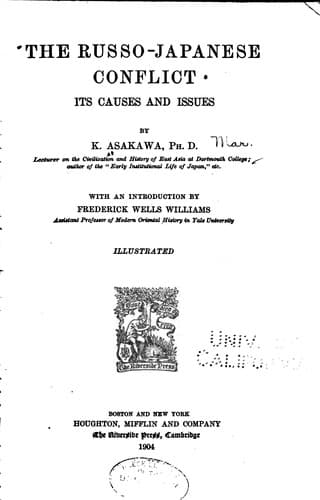
The Russo-Japanese Conflict: Its Causes and IssuesAsakawa, Kan'ichi
History
The Russo-Japanese Conflict: Its Causes and Issues
Asakawa, Kan'ichi
Russo-Japanese War, 1904-1905; Russo-Japanese War, 1904-1905 -- Causes
These demands, as will be seen, comprised, besides the non-alienation of
Manchuria to any other Power, and the _status quo_ in Mongolia, drastic
measures of closing the former territory against the economic enterprise
of all nations but the Russians; and, in that respect, were
supplementary to the Agreement concluded a year before, which studiously
omitted clauses prejudicial to the principle of the open door. From the
standpoint of this last principle, therefore, no demands could be more
objectionable than those now presented by M. Plançon. The Empress
Dowager of China was said to have sneered at the report, and to have
remarked that, if she had been disposed to grant such demands, she would
never have requested the Powers to withdraw as soon as possible their
forces from North China.[467] Prince Ching not only considered the
Russian terms quite unacceptable, but failed to see any reason or right
on the part of Russia to impose fresh conditions which infringed China’s
sovereign rights. He accordingly refused to entertain these conditions,
perhaps on April 23.[468] The Japanese Government had already entered a
firm protest,[469] and was followed by that of the British Government,
which considered the demands as violating the most-favored-nation
clause, and otherwise highly inadmissible.[470] Before the British
protest reached him, Mr. Townley, the British _Chargé_, had assured
Prince Ching that the latter would receive from Great Britain similar
support in resisting the Russian demands to that which was given him
during the negotiation of the Manchurian Convention.[471] Soon
afterward, the United States Government also instructed Mr. Conger to
urge on the Peking Foreign Office the advisability of refusing the first
and second of the conditions laid down by Russia, and, moreover, made
direct inquiries at the Russian Government in a friendly spirit,
pointing out that the reported demands were not in accordance with the
proposed stipulations contained in the new draft treaty between the
United States and China, a copy of which was communicated to Count
Lamsdorff.[472] This latter act of Secretary Hay was promptly followed
by Great Britain, whose Government instructed its Ambassador at St.
Petersburg to address the Foreign Minister in language similar to that
used by the American Representative.[473] It may be safely inferred that
the Japanese Government also took a similar step. There thus resulted a
natural coöperation between the three Powers, whose straightforward
policy was clearly expressed by Lord Lansdowne as follows: “To open
China impartially to the commerce of the whole world, to maintain her
independence and integrity, and to insist upon the fulfillment of treaty
and other obligations by the Chinese Government which they have
contracted towards us.”[474]
Public-domain text, read in full here on John Shaqi.
Reviews
Reviews
No reviews yet
Be the first to share your thoughts on this work.
Elsewhere in the archive
Join the Discussion
Join the discussion
Sign in to leave a comment or review.
Sign InorCreate an account