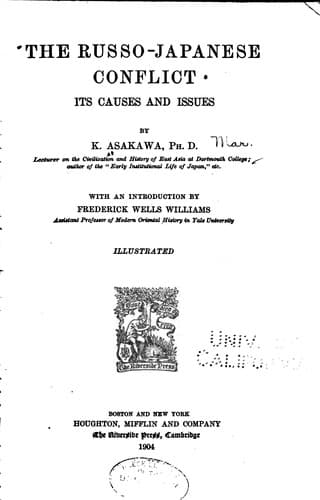
The Russo-Japanese Conflict: Its Causes and IssuesAsakawa, Kan'ichi
History
The Russo-Japanese Conflict: Its Causes and Issues
Asakawa, Kan'ichi
Russo-Japanese War, 1904-1905; Russo-Japanese War, 1904-1905 -- Causes
According to the instructions he had received from his Government, Mr.
MacCormick, the United States Ambassador, had an interview with Count
Lamsdorff in the evening of April 28. The Count at once denied in the
most positive manner that such demands as were rumored had been made by
the Russian Government. He expressed surprise that they should have been
credited in any quarter, and that a friendly government like that of the
United States should be the only one to question him as to whether
Russia could have made demands some of which were on the face of them
ridiculous, as, for instance, those for the right of using China’s
telegraph poles and for the restriction of foreign trade in Manchuria.
It may be questioned whether Count Lamsdorff has ever made to a strong
Power another denial in as positive language, which was, one will soon
observe, as quickly falsified by subsequent events, as this remarkable
disclaimer of April 28, 1903. He went on to say that he could give the
United States Government the most positive assurances that Russia would
faithfully adhere to its pledges regarding Manchuria, and to her
assurances to respect the rights of other Powers. Moreover, American
capital and commerce were what Russia most desired to attract in order
to develop Manchuria. The Count also intimated that any delay in the
evacuation was due to the natural necessity of obtaining assurances that
China was fulfilling her part of the agreement. This could be better
ascertained by the Russian Minister, M. Lessar, who had been absent from
Peking on sick leave, but was about to return to his post, than by an
acting _Chargé d’Affaires_.[475] A careful reading of this disclaimer
will show that it denied that the reported demands had been made by
Russia, but it did not establish that no demands whatsoever had been
made by her. This consideration would seem to make it truly remarkable
that Mr. MacCormick should have been, as he was, entirely satisfied with
the result of the interview, and should have had no further remark to
make. He could perhaps have inquired whether M. Plançon had acted
without authorization, what were the conditions he had proposed, and by
what means M. Lessar was expected to obtain the assurances from China
that her obligations would be fulfilled.[476]
Public-domain text, read in full here on John Shaqi.
Reviews
Reviews
No reviews yet
Be the first to share your thoughts on this work.
Elsewhere in the archive
Join the Discussion
Join the discussion
Sign in to leave a comment or review.
Sign InorCreate an account