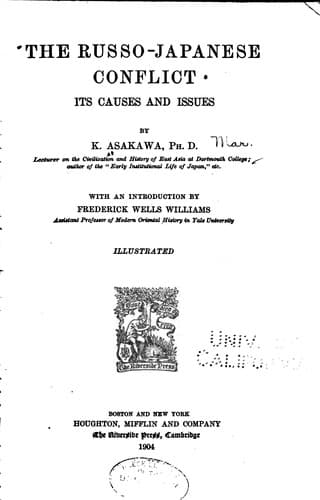
The Russo-Japanese Conflict: Its Causes and IssuesAsakawa, Kan'ichi
History
The Russo-Japanese Conflict: Its Causes and Issues
Asakawa, Kan'ichi
Russo-Japanese War, 1904-1905; Russo-Japanese War, 1904-1905 -- Causes
The positive statements of Count Lamsdorff were partly reinforced and
partly neutralized by the clever remarks made on April 29 by Count
Cassini, the Russian Ambassador at Washington, which appeared in the New
York _Tribune_ of May 1. He considered it unfortunate that Mr. Conger
should have been misinformed, by unreliable parties, of Russia’s
intentions in Manchuria, of which they were grossly ignorant,—a matter
which was regretted, he was sure, no less by the American Government
than by Russia. He, however, not only intimated that some sort of
negotiation was in progress between Russia and China regarding
Manchuria, but was bold enough to say that the United States would
assist Russia in quieting the uneasy sentiment caused by false reports.
He said:—
“Because of the singularity of the interest held by the United
States in Manchuria—for all the world realizes that yours is a
trade, not a territorial one—it lies within the power of your
Government to exert a powerful influence in the preservation of
peace there. Russia’s desire is also for peace, not disturbances, in
Manchuria, and it is to this end that negotiations are now
proceeding in Peking in the effort to establish a condition of
evacuation, and to safeguard Manchuria against a recurrence of the
troubles of 1900.
“Striking evidence of the direct effect in this country caused by
unrest in China was seen in 1900, when, I am told, many cotton mills
in the United States were forced to shut down until conditions in
China were again normal. This fact and the evidence the United
States has already given of its desire to make for peace are
sufficient assurance that the Washington Government will lend its
strong moral support to calm excitement wherever it has been aroused
by the incorrect reports from Peking.”
According to Count Cassini, it was “because of the long standing and
genuine friendliness which, without exception, had characterized the
relations of these two great countries, as well as in recognition of the
frankness with which the American Secretary of State had dealt with my
Government in all diplomatic matters,” that the latter took pleasure in
assuring the United States regarding negotiations pending with another
Power, “even though in so doing all diplomatic precedent was broken.” “I
am not aware,” he said, “that any other Powers have received from the
Foreign Office [of St. Petersburg] such a statement as was handed your
Ambassador.” In referring to Mr. MacCormick’s interview, however, it
will be seen that Count Lamsdorff made no direct reference to the
negotiations at Peking, still less to their contents, and the assurances
he gave had before and have since been frequently and in similar terms
repeated to other Powers by Russia.
Public-domain text, read in full here on John Shaqi.
Reviews
Reviews
No reviews yet
Be the first to share your thoughts on this work.
Elsewhere in the archive
Join the Discussion
Join the discussion
Sign in to leave a comment or review.
Sign InorCreate an account