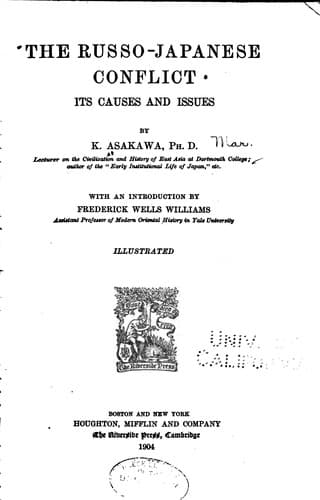
The Russo-Japanese Conflict: Its Causes and IssuesAsakawa, Kan'ichi
History
The Russo-Japanese Conflict: Its Causes and Issues
Asakawa, Kan'ichi
Russo-Japanese War, 1904-1905; Russo-Japanese War, 1904-1905 -- Causes
Count Lamsdorff’s disclaimer was uttered on April 28, and Count
Cassini’s statement was dated April 29 and appeared in the press on May
1. In the mean time, the Foreign Office of Peking had refused the
Russian conditions in an official note. Yet, on April 29, M. Plançon
suggested that each condition might be answered separately, and the
suggestion was verbally refused by Prince Ching. Thereupon the Russian
_Chargé_ presented a note intimating that his Government wished to be
assured on the first three of the original demands, namely, whether a
territorial cession to another power in the Liao Valley was contemplated
by China; whether there was an intention to assimilate the
administration of Mongolia to that of China proper; and whether China
would permit the appointment of foreign Consuls in Manchuria in other
places than Niu-chwang. In reply, Prince Ching stated, naturally, that
there had never been any question of ceding territory in the Liao Valley
to a foreign Power; that the question of altering the administrative
system of Mongolia had been discussed, but it had been disapproved by
the Throne, and was not under consideration for the present; and that,
in regard to the appointment of new Consuls in Manchuria, it depended
upon the opening of new ports, which would be decided only by the extent
of the commercial development of Manchuria.[477] On the next day, or, as
the late Sir M. Herbert rather inaccurately wrote to Lord Lansdowne,
“two days after the Russian Government had categorically denied that the
demands had been made,” M. Plançon reiterated to Prince Ching, not
three, but all, of the seven conditions, and, consequently, the Chinese
treaty commissioners at Shanghai were instructed, for the present, to
refuse to their American colleagues the opening of treaty ports in
Manchuria, which the latter had been demanding. The United States
Government, however, taking little heed of M. Cassini’s argument,
instructed its commissioners at Shanghai, on the strength of Count
Lamsdorff’s denial, to insist upon the opening of new Manchurian
ports.[478] Against this demand, M. Plançon seems to have renewed his
pressure upon the Chinese Government several times during May,[479]
saying that he had received no instructions from St. Petersburg to
revoke his opposition.[480] At last, Secretary Hay instructed Mr. Conger
to suggest to M. Lessar, on the latter’s arrival at Peking, that a
simultaneous communication should be made by them to the Peking Foreign
Office to the effect that the Russian Government had, as Count Lamsdorff
had said, no objection to the opening of the treaty ports.[481] The
Russian Minister returned to Peking toward the end of May, and
telegraphed to his Government the suggestion made by the American
Government.[482] He, as well as M. Cassini, renewed the assurance that
Russia was not opposed to the opening of the ports, and Mr. MacCormick,
who returned on leave to Washington, confirmed the assurance.[483]
Public-domain text, read in full here on John Shaqi.
Reviews
Reviews
No reviews yet
Be the first to share your thoughts on this work.
Elsewhere in the archive
Join the Discussion
Join the discussion
Sign in to leave a comment or review.
Sign InorCreate an account