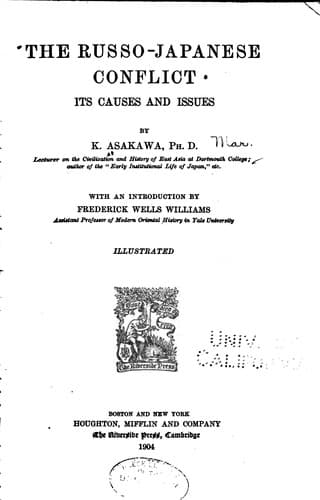
The Russo-Japanese Conflict: Its Causes and IssuesAsakawa, Kan'ichi
History
The Russo-Japanese Conflict: Its Causes and Issues
Asakawa, Kan'ichi
Russo-Japanese War, 1904-1905; Russo-Japanese War, 1904-1905 -- Causes
Secretary Hay now hoped that the only possible opposition to be met
would come from none but the Chinese Government, and requested the
support in the matter[484] of the British and Japanese Ministers at
Peking, which was willingly given. So late as on June 5, however, M.
Cassini addressed a note to Mr. Hay, inquiring what was the meaning
attached by the United States Government to the term “treaty port,” and
what action it wished Russia to take. Mr. Hay could only refer, in
answer to the first query, to the correspondence which passed between
the Russian and the United States Governments in 1899,[485] and request,
in reply to the second, that Russia should inform China that it was
untrue that the former was, as had been stated by China, preventing the
opening of the treaty ports.[486] Secretary Hay was so urgent about this
matter that he considered it indifferent whether the opening was granted
in a treaty or, as a compromise, by a special Imperial edict.[487] M.
Lessar had the first interview after his return with Prince Ching on
June 10,[488] and, according to the Japanese press, renewed the original
seven conditions,[489] including the refusal of ports. The Prince was
believed to have refused to discuss any of the conditions except those
regarding the establishment of a sanitary board and the payment of
customs duties into the Russo-Chinese Bank at Niu-chwang, which might be
reconsidered. The Prince was then granted another five days’ sick leave,
returned to the summer palace, and declined to see any foreign
Minister.[490] Rumors were then afloat which would have one believe that
the Prince, in spite of the earnest protests of the British and Japanese
Representatives, was gradually yielding to Russian influence. It is at
least significant that at this critical point he informed Mr. Townley,
the British _Chargé d’Affaires_, on June 19, that an agreement would
soon be arrived at with Russia whereby Manchuria would be preserved to
China without any loss of sovereign rights. He added that China would
open treaty ports in Manchuria, if she saw fit, after the Russian
evacuation.[491] The significance of these remarks could easily be read
between the lines. Not only was the Russian evacuation uncertain, but
also it was no less patent to Russia than to China that, in the marts,
the opening of which was under discussion, namely, Mukden and perhaps
Harbin, as well as An-tung and Tatung-kao near the Korean boundary, the
immediate trade prospects were not considered so great as the political
danger which their opening might to some degree avert. Had the
evacuation been certain, and had the commercial consideration been the
sole question involved, it would have been unnecessary either to hasten
their opening or even to select those very places. Nor would MM.
Cassini, Lessar, and Plançon have been so strongly opposed to the
proposition. Seen in the light of these considerations, Prince Ching’s
Public-domain text, read in full here on John Shaqi.
Reviews
Reviews
No reviews yet
Be the first to share your thoughts on this work.
Elsewhere in the archive
Join the Discussion
Join the discussion
Sign in to leave a comment or review.
Sign InorCreate an account