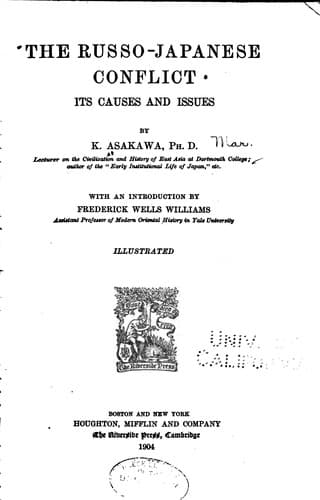
The Russo-Japanese Conflict: Its Causes and IssuesAsakawa, Kan'ichi
History
The Russo-Japanese Conflict: Its Causes and Issues
Asakawa, Kan'ichi
Russo-Japanese War, 1904-1905; Russo-Japanese War, 1904-1905 -- Causes
new position appeared plainly to indicate the gaining of Russian
influence upon the helpless Foreign Office of Peking.
[Illustration:
M. LESSAR
_Russian Minister at Peking_
]
Nor for two years and a half since the first agreement was reported to
have been concluded between Admiral Alexieff and Tartar General
Tsêng-chi, had the Manchuria question vexed the world. If the question
had concerned none but Russia and China, and the former had been slow to
promise and loyal to her pledges and the latter strong enough to guard
her own interest, the uncertain conditions in Manchuria would not have
constituted, as they did, a grave and continual menace to the general
peace of the Far East. Unfortunately, the Russian pledges, on the one
hand, were attended by serious conditions, some of which it seemed
impossible to fulfill and others contrary to the recognized principles
of international intercourse to which Russia had professed constant
devotion, and, on the other, China had again and again shown herself
impotent to resist what she would otherwise reject. Above all, Great
Britain and the United States were, both from interest and from
principle, firmly committed in the East to a policy which was in
constant danger of being undermined by the conduct of Russia. For Japan,
however, the Manchurian question possessed an even graver significance,
for, with the fall of the Three Eastern Provinces into the Russian
hands, the independence of Korea, as well as the security of Japan
herself, would be threatened, while a consequent closure of Manchuria
against Japan’s economic activity would seriously maim her growth and
life as a nation. It was now considered, therefore, that the irritating
situation should no longer be allowed to continue, and that the time had
at last come when Japan should with determination deal _directly_ with
Russia, in order to effect once for all an arrangement satisfactory and
beneficial to all the parties concerned and to the world at large.
-----
Footnote 445:
_China, No. 2 (1904)_, No. 57, inclosure (Hosie to Satow, November 7,
1902). Also No. 106 (Townley to Lansdowne, May 5, 1903).
Footnote 446:
_Ibid._, No. 128 (Hosie, June 22, 1903).
Footnote 447:
_Ibid._, No. 116 (April 8).
Footnote 448:
_China, No. 2 (1904)_, No. 75 (April 15); 113 (May 14).
Footnote 449:
For the Manchurian side, see p. 227, above. The timber concession on
the Korean side will be taken up in a later section.
Footnote 450:
_China, No. 2 (1904)_, Nos. 75, 115, 128.
Footnote 451:
_Ibid._, Nos. 115, 129.
Footnote 452:
Pp. 289 ff., 318 ff., below.
Footnote 453:
Article 8. See pp. 130–131, above.
Footnote 454:
See p. 235, note 4, above.
Footnote 455:
_China, No. 2 (1904)_, No. 130, inclosure (May 4, 1903).
Footnote 456:
_Ibid._, No. 71 (April 14).
Footnote 457:
_Ibid._, No. 122.
Footnote 458:
_Ibid._, No. 130, inclosure (May 4).
Footnote 459:
_Ibid._
Footnote 460:
Public-domain text, read in full here on John Shaqi.
Reviews
Reviews
No reviews yet
Be the first to share your thoughts on this work.
Elsewhere in the archive
Join the Discussion
Join the discussion
Sign in to leave a comment or review.
Sign InorCreate an account