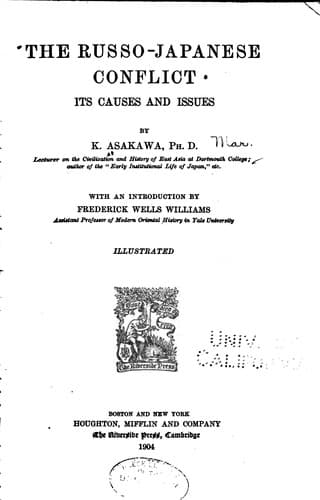
The Russo-Japanese Conflict: Its Causes and IssuesAsakawa, Kan'ichi
History
The Russo-Japanese Conflict: Its Causes and Issues
Asakawa, Kan'ichi
Russo-Japanese War, 1904-1905; Russo-Japanese War, 1904-1905 -- Causes
Manchuria, however, constituted only one half—perhaps the less important
half—of the great Eastern problem which perplexed the world and
imperiled the future life of Japan. In the other half, namely, Korea,
Japan was confronted by a situation similar and closely allied to that
in Manchuria, and more directly menacing to herself. Let us briefly
describe the evolution of the complex Korean question which ensued upon
the Chinese-Japanese war of 1894–5.
The war had arisen from the conflicting wishes of the belligerent Powers
regarding Korea, China asserting suzerain rights over the Peninsular
Kingdom, and the interests of Japan making its effective independence
imperative. Unfortunately, Korea’s lack of material strength rendered
her real independence impossible, and her strength could be secured,
from the Japanese point of view, only by a thoroughgoing reform of her
administrative, financial, and economic system, which had sunk into a
state of unspeakable corruption and decay. By her victory, the colossal
task devolved upon Japan of reforming the national institutions of a
people whose political training in the past seemed to have made them
particularly impervious to such an effort. Perhaps no work more delicate
and more liable to blunder and misunderstanding could befall a nation
than that of setting another nation’s house in order who would not feel
its necessity. In this difficult enterprise, the Japanese showed
themselves as inexperienced as the Koreans were reluctant and resentful.
Three million _yen_ were furnished by Japan to Korea in the interest of
various reforms, as also were numerous councilors, including such able
men as Shūichirō Saitō and the late Tōru Hoshi. Some of the others,
however, were either inferior in attainments or impatient of slow
processes. The entire movement was intrusted to the direction of the new
Japanese Minister, Count K. Inoüé, a generous, brilliant, and bold
statesman. He presented to the Korean sovereign a plan of reform, which
included the proposal to remove from her share of political control the
versatile Queen, whose family of the Min had grown powerful by means of
the abuses which the Count wished to eradicate. In this attempt, in
which he was largely successful, of drawing a line of demarcation
between the Court and the Government, he inevitably incurred the deep
ire of the family whose influence had been predominant both at the
capital and in the country. Other measures of his reform further
antagonized the official nobility of the Kingdom.[492] The influence of
the Count, however, was so great, and the training of Korean troops by
Japanese officers seemed so successful, that even the domineering Queen
was obliged to await a more favorable moment to regain her lost
prestige.
Public-domain text, read in full here on John Shaqi.
Reviews
Reviews
No reviews yet
Be the first to share your thoughts on this work.
Elsewhere in the archive
Join the Discussion
Join the discussion
Sign in to leave a comment or review.
Sign InorCreate an account