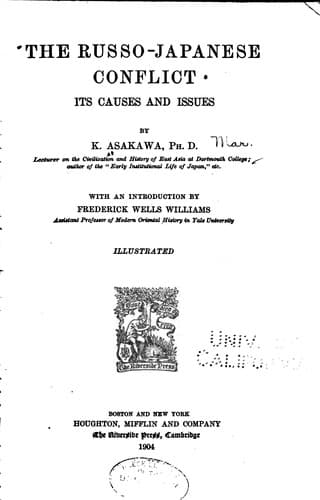
The Russo-Japanese Conflict: Its Causes and IssuesAsakawa, Kan'ichi
History
The Russo-Japanese Conflict: Its Causes and Issues
Asakawa, Kan'ichi
Russo-Japanese War, 1904-1905; Russo-Japanese War, 1904-1905 -- Causes
At that time Russia was represented at Seul by M. Waeber, who had been
in Korea for more than ten years, and whose personality and diplomatic
arts had won him warm friends in the Court, particularly the Queen and
her party. At one time, before the late war, when the ascendency of the
Chinese Resident, Yuan Shi-kai, had created disaffection among certain
Koreans, M. Waeber was said to have succeeded in quietly allying himself
with those people and promoting Russian influence over them.[493] It was
now again found possible for him and his talented wife to recommend
themselves to the large body of men and women whose feeling the Japanese
had in one way or another alienated, and slowly but surely to undermine
the latter’s influence in Seul.[494] The successful coercion of Japan by
the three Powers after the treaty of Shimonoseki must also have gone far
toward reducing the prestige of Japan in the eye of the Koreans, who are
singularly susceptible to the influence of events of this nature.
As soon as Count Inoüé left Seul, the Queen again came to the front. On
July 7, 1895, she suddenly accused of treason the most influential
member of the Cabinet and chief of the pro-Japanese party, Pak Yong-hio,
who again had to flee to Japan, where he had recently spent ten years of
a refugee’s life.[495] Count Inoüé returned to Seul, and again the Queen
held her breath. A Cabinet was organized of partisans of reform. The
Count was, however, relieved of his post late in July, and in September
was succeeded as the Japanese Minister by Viscount Lieutenant-General
Gorō Miura, a man of undoubted sincerity, but utterly without diplomatic
training. No sooner had Inoüé left Korea than the Queen reasserted
herself, increased the personnel of her household, and restored many of
her old extravagances so lately removed by the reformer. She had been
further embittered by the sharp rivalry shown against her and the Min by
the King’s father, Tai-wen-kun, and his party. The Queen finally planned
a _coup d’état_, early in October, with a view to disbanding the
soldiers trained by Japanese officers and replacing the progressive
Cabinet members with her friends. A crisis was imminent, and it was at
this juncture that some of the Japanese in Seul betrayed themselves into
a crime which caused a bitter disappointment and lasting disgrace to the
Government and the nation at home. Perceiving that a passive attitude
would result in a great calamity, certain Koreans and Japanese rose
early on October 8, to bring Tai-wen-kun out of his secluded residence.
Accompanied by two battalions of trained soldiers, the veteran statesman
rode toward the King’s palace, where he was to present a plan of reform,
but was opposed by the guard, who fired at his escort. In the midst of
the mêlée which ensued, some of the bravoes rushed into the Inner Palace
and murdered the Queen.[496] The deed was no less crushing a blow to the
Japanese nation than it was to the bereaved King of Korea, for the
Public-domain text, read in full here on John Shaqi.
Reviews
Reviews
No reviews yet
Be the first to share your thoughts on this work.
Elsewhere in the archive
Join the Discussion
Join the discussion
Sign in to leave a comment or review.
Sign InorCreate an account