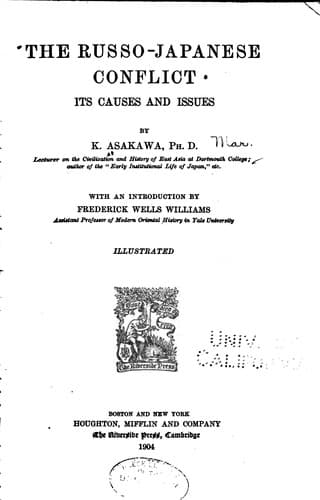
The Russo-Japanese Conflict: Its Causes and IssuesAsakawa, Kan'ichi
History
The Russo-Japanese Conflict: Its Causes and Issues
Asakawa, Kan'ichi
Russo-Japanese War, 1904-1905; Russo-Japanese War, 1904-1905 -- Causes
The King being virtually in the custody of the Russians, their
ascendency resulted as a matter of course. They secured, among other
things, an immense timber concession on the northern frontier and on
Uinung Island,[499] and a mining concession along the Tumên River.[500]
The Korean forces trained by Japanese officers were abolished in
May,[501] and the Japanese soldiers stationed at the ports and Seul also
were reduced in number.[502]
The Government at Tokio even appeared, for a time at least, to forsake
its historic policy of safe-guarding Korea’s independence by its sole
aid, but to seek Russia’s coöperation toward the same end. With this
object in view, Japan seized the occasion of the coronation of the Czar
to send Field Marshal Marquis Aritomo Yamagata[503] as special envoy to
St. Petersburg, with a commission to negotiate with the Russian
Government an agreement regarding the relative position of the two
Powers in Korea. The result was the following Yamagata-Lobanoff
Protocol, signed on June 9, 1896:—
“ARTICLE I. The Japanese and Russian Governments should, with the
object of remedying the financial embarrassments of Korea, counsel
the Korean Government to suppress all unnecessary expenses and to
establish an equilibrium between expenditure and revenue. If, as a
result of the reforms which should be considered indispensable, it
should become necessary to have recourse to foreign debts, the two
Governments should, of a common accord, render their support to
Korea.
“ARTICLE II. The Japanese and Russian Governments should try to
abandon to Korea, in so far as the financial and economic situation
of that country should permit, the creation and the maintenance of
an armed force and of a police organized of native subjects, in
proportions sufficient to maintain internal order, without foreign
aid.
“ARTICLE III. With a view to facilitating communications with Korea,
the Japanese Government shall continue to administer the telegraphic
lines which are actually in its possession.
“It is reserved to Russia to establish a telegraphic line from Seul
to her frontier.
“These various lines should be purchased by the Korean Government,
as soon as it finds means so to do.
“ARTICLE IV. In case the principles above expounded require a more
precise and more detailed definition, or if in the future other
points should arise about which it should be necessary to consult,
the Representatives of the two Governments should be instructed to
discuss them amicably.”[504]
Public-domain text, read in full here on John Shaqi.
Reviews
Reviews
No reviews yet
Be the first to share your thoughts on this work.
Elsewhere in the archive
Join the Discussion
Join the discussion
Sign in to leave a comment or review.
Sign InorCreate an account