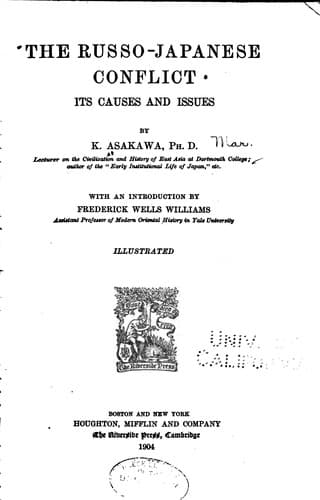
The Russo-Japanese Conflict: Its Causes and IssuesAsakawa, Kan'ichi
History
The Russo-Japanese Conflict: Its Causes and Issues
Asakawa, Kan'ichi
Russo-Japanese War, 1904-1905; Russo-Japanese War, 1904-1905 -- Causes
A few days earlier, on May 14, there was concluded at Seul between M.
Komura and M. Waeber, the Japanese and Russian Ministers, a Memorandum
dealing with matters of more immediate interest to the two Powers.[505]
M. Waeber agreed to advise the Korean King to return from the Russian
Legation to his palace, as soon as there was no more apprehension for
his safety, M. Komura pledging in return to keep the Japanese political
bravoes (_sō-shi_) in Seul under a strict surveillance (Article I.). It
was declared that the present Cabinet members[506] of Korea were noted
for generous and mild principles, and had been appointed to their posts
by the King of his own accord. The Japanese and Russian Representatives
should always make it their aim to advise the King to govern his people
in generous spirit (Article II.). The remainder of the Memorandum is
more worthy of record:—
“ARTICLE III. The Representative of Russia quite agrees with the
Representative of Japan that, at the present state of affairs in
Korea, it may be necessary to have the Japanese guards stationed at
some places for the protection of the Japanese telegraph line
between Fusan and Seul, and that these guards, now consisting of
three companies of soldiers, should be withdrawn as soon as possible
and replaced by gendarmes, who will be stationed as follows: fifty
men at Tai-ku, fifty men at Ka-heung, and ten men each at ten
intermediate posts between Fusan and Seul. This distribution may be
liable to some changes, but the total number of gendarme force shall
never exceed 200 men, who will afterwards be gradually withdrawn
from those places in which peace and order have been restored by the
Korean Government.[507]
“ARTICLE IV. For the protection of the Japanese settlements at Seul
and the open ports against the possible attacks by the Korean
populace, two companies of Japanese troops may be stationed at Seul,
one company at Fusan and one at Gensan, each company not to exceed
200 men. These troops shall be quartered near the settlements, and
should be withdrawn as soon as no apprehensions of such attacks
could be entertained.
“For the protection of the Russian Legation and Consulates, the
Russian Government may also keep guards not exceeding in number the
Japanese troops at these places, which will be withdrawn as soon as
tranquillity in the interior is completely restored.”[508]
Public-domain text, read in full here on John Shaqi.
Reviews
Reviews
No reviews yet
Be the first to share your thoughts on this work.
Elsewhere in the archive
Join the Discussion
Join the discussion
Sign in to leave a comment or review.
Sign InorCreate an account