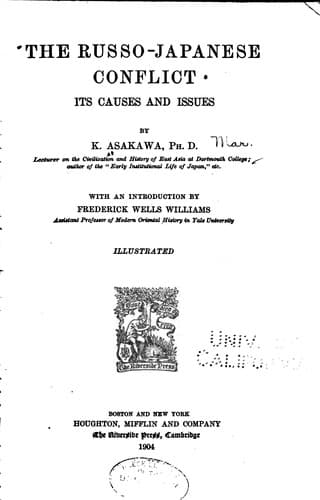
The Russo-Japanese Conflict: Its Causes and IssuesAsakawa, Kan'ichi
History
The Russo-Japanese Conflict: Its Causes and Issues
Asakawa, Kan'ichi
Russo-Japanese War, 1904-1905; Russo-Japanese War, 1904-1905 -- Causes
A casual reading of these agreements will show how far the Japanese
Government had receded from the position she originally took in regard
to Korea. Ever since Japan concluded her treaty with Korea in 1876,[509]
which for the first time established the international position of the
latter State as a sovereign Power, Japan’s policy had been to uphold the
independence and the opening of the Peninsular Kingdom. From the strict
terms of this policy, Japan has allowed herself to depart twice,—in her
agreements, first, with China in 1885, and, again, with Russia in
1896,—not by forsaking its principles, but in each case by entering, in
the pursuit of the policy, into an impossible association with an
aggressive Power. In each of the two instances the attempt failed within
a decade, and resulted in hostilities. In 1885, Japan and China
simultaneously withdrew their forces from Korea, and thereby cleared the
ground for the renewed conflict of their opposing interests, which were
artificially placed on a par with one another. In 1896, Japan admitted
Russia’s right to build a telegraph line in North Korea which should
correspond to the Japanese line in the south, and to station in Korea a
number of troops equal to that of the Japanese soldiers. Despite the
millenniums of her historic relations with Korea, and the actual
preponderance of her interests therein, and after her successful
liberation of the Kingdom from Chinese suzerainty by a costly war,
Japan, now admitted into the Peninsular politics on an equal footing
with herself a Power which owed its bright success to a mere diplomacy
of less than two years’ standing, and whose policy seemed to be guided
by principles entirely at variance with the independence and strength of
Korea.
At the coronation of the Czar, Korea was represented by an influential,
pro-Russian member of the Min family. It was then rumored that he
concluded with the Russian Government a secret agreement by which Korea
undertook to employ Russian military instructors and financial
councilors. However that may be, the Russian Representatives at Seul are
said to have since appealed more than once to the “secret agreement” in
their attempts to force the engagement of Russian service upon the
Korean Government.[510] If these reports were true, no better proof of
the light estimate with which Russia from the first regarded the
Yamagata-Lobanoff Protocol could be found than her alleged agreement
with Min Yong-hwan, for the latter was a direct reversal of the first
two Articles of the former. Russia may be credited with having
succeeded, by her separate and mutually contradictory arrangements with
Min, Yamagata, and Li Hung-chang,[511] in simultaneously bringing the
three Eastern Powers to terms.
Public-domain text, read in full here on John Shaqi.
Reviews
Reviews
No reviews yet
Be the first to share your thoughts on this work.
Elsewhere in the archive
Join the Discussion
Join the discussion
Sign in to leave a comment or review.
Sign InorCreate an account