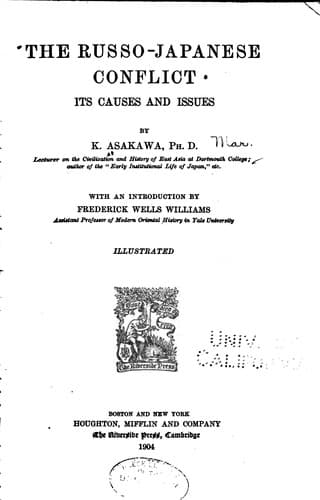
The Russo-Japanese Conflict: Its Causes and IssuesAsakawa, Kan'ichi
History
The Russo-Japanese Conflict: Its Causes and Issues
Asakawa, Kan'ichi
Russo-Japanese War, 1904-1905; Russo-Japanese War, 1904-1905 -- Causes
It was a misfortune to Russia that her able representative at Seul, M.
Waeber, who had been in Korea since 1884, had been transferred to
Mexico, and was replaced by M. Speyer. The former diplomat’s pleasing
manners were succeeded by the latter’s overbearing conduct, which
appeared gradually to alienate from Russian influence many a former
friend of M. Waeber. The anti-Russian sentiment grew finally so strong
that a large number of intelligent Koreans organized the Korean
Independence Society, whose object was declared to be to restore the
military, financial, and political control of the Kingdom to the hands
of the Koreans. The impatient M. Speyer was reported to have written a
note to the Korean Government, on March 7, 1898, asking for a reply
within twenty-four hours to the query whether Korea was really in want
of the service of the Russian experts, whose position had become rather
precarious. The astounded Government replied politely but firmly in the
negative. Other events occurred which further evinced the arbitrary
attitude of M. Speyer. With an equally astonishing decision, he ordered,
on March 17, all the financial and military councilors to be recalled to
Russia. The Russo-Korean Bank was also disorganized. M. Speyer himself
leaving Korea in April, his post was occupied by the amiable M.
Matunine.[514] About this time, a new Russo-Japanese Protocol was signed
at Tokio between Baron Rosen, the Russian Minister to Japan, and Baron
Nishi, the Foreign Minister of the Japanese Government.
It is evident that the relaxation of Russia’s diplomacy in Korea was in
no small measure due to the swift movement of events, as well as her own
all-engrossing activity, in China. The Nishi-Rosen Protocol of April 25,
1898, concluded as it was at this unfavorable moment for Russia, was far
more in Japan’s favor than the agreements of 1896. It not only gave an
explicit recognition of the independence of Korea, but also incorporated
in the second Article the best principles of the previous agreement,
and, in addition, fully recognized the special economic interests of
Japan in the Peninsula. The entire Protocol deserves quotation:—
“ARTICLE I. The Imperial Governments of Japan and Russia definitely
recognize the independence and the perfect sovereignty of Korea, and
mutually engage to abstain from all direct interference in the
internal affairs of that country.
“ARTICLE II. Desirous of removing all possible causes of
misunderstanding in the future, the Imperial Governments of Japan
and Russia mutually engage, in case Korea should have recourse to
the counsel and assistance of either Japan or Russia, not to take
any measure regarding the nomination of military instructors and
financial advisers, without having previously arrived at a mutual
accord on the subject.
Public-domain text, read in full here on John Shaqi.
Reviews
Reviews
No reviews yet
Be the first to share your thoughts on this work.
Elsewhere in the archive
Join the Discussion
Join the discussion
Sign in to leave a comment or review.
Sign InorCreate an account