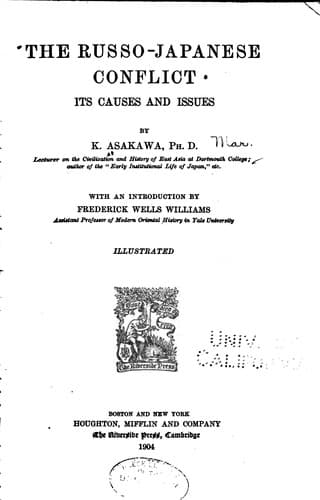
The Russo-Japanese Conflict: Its Causes and IssuesAsakawa, Kan'ichi
History
The Russo-Japanese Conflict: Its Causes and Issues
Asakawa, Kan'ichi
Russo-Japanese War, 1904-1905; Russo-Japanese War, 1904-1905 -- Causes
“ARTICLE III. In view of the great development of the commercial and
industrial enterprises of Japan in Korea, as also of the
considerable number of the Japanese subjects residing in that
country, the Russian Imperial Government shall not obstruct the
development of the commercial and industrial relations between Japan
and Korea.”[515]
Each one of these three Articles should be carefully noted, for five
years later, in 1903, they, together with the last Article of the
Yamagata-Lobanoff Protocol of June 9, 1896, became a conventional ground
for Japan’s direct negotiations with Russia which preceded the present
war. Particular attention is called to the third Article, wherein Russia
recognized for the first time the peculiar interest of the Japanese
nation in the economic development of Korea.
Less artificial as the Protocol was in comparison with the former
agreements, it was, however, hardly adequate as an instrument to
reconcile the conflicting interests of Russia and Japan. Fresh
complications could well be expected from the second Article, for it, on
the other hand, barred the reformatory attempts of a Power whose
interests demanded the independence and strength of Korea, and, on the
other, cleared the ground for the renewed activity of another Power
which had little intention to abstain from undermining the vital
interests of Japan. Under these precarious circumstances was opened the
second period of the Russo-Japanese relations in Korea.
-----
Footnote 492:
Cf. _Dōbun-kwai_, No. 49, p. 7.
Footnote 493:
_Tokushu Jōyaku_, pp. 731–732.
Footnote 494:
_Ibid._, p. 740.
Footnote 495:
G. Takeda, _Kinji Kyokutō Gwaikō Shi_ (recent history of diplomacy in
the Far East, Tokio, 1904), pp. 22–23.
Footnote 496:
G. Takeda, pp. 25–30; Y. Hamada, _Nichi-Ro Gwaikō Jūnen Shi_ (ten
years of Japanese-Russian diplomacy, Tokio, 1904), p. 47. Also see the
_Korea Review_, July (pp. 331–336) and August (pp. 369–371), 1904.
Footnote 497:
G. Takeda, pp. 30–32.
Footnote 498:
_Ibid._, pp. 33–34; _Tokushu Jōyaku_, pp. 740–741. See also the _Korea
Review_, August, 1904, pp. 377–378.
Footnote 499:
The contract dated August 28, 1896 (o. s.).—_Tokushu Jōyaku_, pp.
781–791.
Footnote 500:
The contract of April 22, 1896.—_Ibid._, pp. 772–775.
Footnote 501:
G. Takeda, p. 45.
Footnote 502:
_Tokushu Jōyaku_, pp. 740–741.
Footnote 503:
It is said that Marquis Itō himself had a mind to represent Japan at
the coronation, but the mission was finally intrusted to the Field
Marshal. It will be remembered that China sent Li Hung-chang for this
occasion.
Footnote 504:
_Tokushu Jōyaku_, pp. 742–744; the _Kaitei Jōyaku Isan_, pp. 601–602;
the _Treaties and Conventions between the Empire of Japan and other
Powers_, p. 393.
Footnote 505:
See the same references as are given in the preceding note, pp.
740–742, 596–600, and 391, respectively.
Footnote 506:
Some of them were strongly pro-Russian.
Public-domain text, read in full here on John Shaqi.
Reviews
Reviews
No reviews yet
Be the first to share your thoughts on this work.
Elsewhere in the archive
Join the Discussion
Join the discussion
Sign in to leave a comment or review.
Sign InorCreate an account