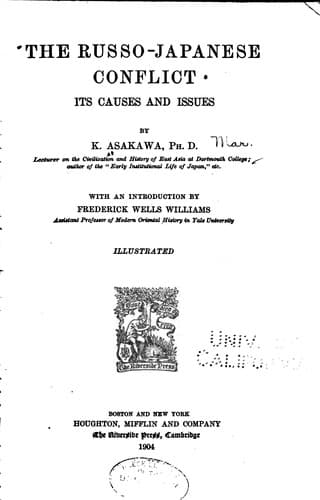
The Russo-Japanese Conflict: Its Causes and IssuesAsakawa, Kan'ichi
History
The Russo-Japanese Conflict: Its Causes and Issues
Asakawa, Kan'ichi
Russo-Japanese War, 1904-1905; Russo-Japanese War, 1904-1905 -- Causes
Turning now to the diplomacy at the Korean capital, we observe that its
first aim seems to have been to repeat the old policy of replacing Mr.
MacLeavy Brown, a British subject, as the Director-General of Korean
Customs, with M. Kir Alexieff, and also to put Korea under financial
obligation to Russia by means of a loan. In March, 1901, Mr. Brown was
suddenly ordered by the Korean Government, which acted obviously at the
instance of the Russian Representative, to vacate his residence and
surrender his post. The British _Chargé_, Mr. Gubbins, had barely
succeeded in prevailing upon the Korean Government to revoke the latter
half of the order, when in May another order was issued calling for the
delivery, not only of Mr. Brown’s official residence, but also of the
customs office building—an order equivalent to a dismissal from office.
From this predicament Mr. Brown was narrowly rescued by an earnest
representation made on May 5 by Mr. Hayashi to the Korean Emperor.[526]
By this time, the affair had been complicated by an agreement of a
5,000,000 _yen_ loan, which had been signed on April 19, between the
Korean Government and the French agent, M. Cazalis, of the Yunnan
Syndicate.[527] It is hardly necessary to give the detail of this
abortive agreement, for it was never ratified by the Emperor, but fell
through from the inability of the Syndicate to fulfill its terms.[528]
It is only necessary to say that if the loan had materialized, a large
control over the coinage, mining, and general finances of Korea would
have passed into the hands of the French subjects and perhaps also of
the Russo-Chinese Bank. This Bank, in the latter half of 1902, seems to
have offered a fresh loan through its agents at Seul, Gunzburg and
Company, under the condition that the firm should obtain a permanent
monopoly of ginseng, which had then been in the hands of the Japanese,
and also the right of working certain mines.[529] This proposition also
miscarried, evidently owing to the protest from the Japanese Minister,
who discovered in it a violation of the first Article of the
Yamagata-Lobanoff Protocol of June 9, 1896. A Belgian loan, which was
rumored early in 1903, seems to have shared the same fate with all the
loans previously suggested.[530]
In this connection, it should be noted, in justice to all the parties
concerned, that toward the latter half of 1900 there was a movement in
Japan to suggest a loan to the Korean Government, but that the Premier,
Marquis Yamagata, declined to countenance the scheme.[531] He probably
did not wish his nation to become a party to a violation of an agreement
it made with Russia in 1896.
Public-domain text, read in full here on John Shaqi.
Reviews
Reviews
No reviews yet
Be the first to share your thoughts on this work.
Elsewhere in the archive
Join the Discussion
Join the discussion
Sign in to leave a comment or review.
Sign InorCreate an account