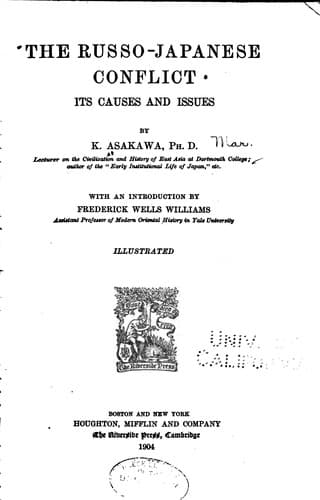
The Russo-Japanese Conflict: Its Causes and IssuesAsakawa, Kan'ichi
History
The Russo-Japanese Conflict: Its Causes and Issues
Asakawa, Kan'ichi
Russo-Japanese War, 1904-1905; Russo-Japanese War, 1904-1905 -- Causes
In 1902–3, the interest of Russia was represented at Seul, not only by
her regular Representative, but also by Baron Gunzburg, who served as an
agent for many an economic enterprise in Korea proposed by the Russians,
by an Alsatian lady, Mlle. Sonntag, a relative of Mme. Waeber and an
influential member of the court circle, and, temporarily, by M. Waeber
himself,[532] who had come to Seul as special envoy of the Czar to
attend the fortieth anniversary of the accession of the Korean Sovereign
to the throne.[533] These persons were further supported by a few
Koreans who had lived in Siberia and adopted Russian citizenship, and
whose rapid promotion in office had excited jealousy among the nobility
in Seul.[534] Among the latter, also, there were Russian sympathizers of
the greatest political influence. Taking advantage of the continual
discord among the politicians in Seul, which at that time manifested
itself in the rancorous hatred between the supporters of the Crown
Prince and those of Lady Öm, who aspired to the position of the Queen,
the Russians succeeded in enlisting the good-will of the leaders of both
parties, Yi Yong-ik and Yi-Keun-thaik. Once a lad of mean birth in the
north,[535] Yi Yong-ik, by his unscrupulous methods, had amassed a large
fortune and risen to the Ministry of the Imperial Household, until, in
November, 1902, he found himself the object of a sharp opposition by Yi
Keun-thaik and a large section of the gentry of Seul. He at once took
refuge in the Russian Legation, and was then taken on board the
“Korietz” to Port Arthur, where he used his seal of the Imperial Estates
Board and transacted his official business as before.[536] On January
13, 1903, he returned to Seul, and used his influence to further the
already started obstruction to the bank-notes issued by the Korean
branch of the First Bank of Japan. These notes had first appeared in
May, 1902, and, beside the deplorable monetary system of Korea, met so
great a demand from the commercial world that, by the end of the year,
the amount issued had risen nearly to 1,000,000 _yen_ against a reserve
only a little below that sum.[537] Suddenly, at the instance of the
Russians who wished to issue similar notes from the Russo-Chinese Bank,
the Korean Government had prohibited the circulation of the Japanese
notes in December, 1902. The credit of the notes and the benefit of
their use had been so obvious, however, that, in spite of the Government
order, the Director-General of the Customs had still received payments
in them, and the Chinese Minister had advised his countrymen to continue
their use. The veto had then been removed, only to be renewed at the
return of Yi Yong-ik from Port Arthur. He had entertained the desire,
which has been found utterly impracticable, of himself establishing a
central bank and issuing paper notes.[538] He employed all the means at
his disposal to resist the opposition of the Japanese Representative,
Public-domain text, read in full here on John Shaqi.
Reviews
Reviews
No reviews yet
Be the first to share your thoughts on this work.
Elsewhere in the archive
Join the Discussion
Join the discussion
Sign in to leave a comment or review.
Sign InorCreate an account