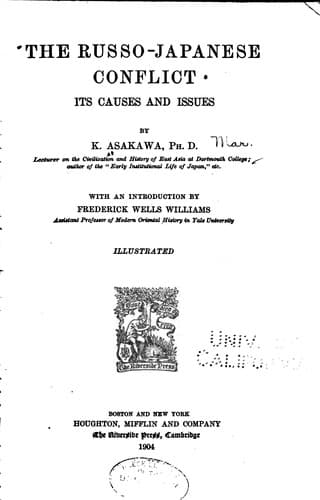
The Russo-Japanese Conflict: Its Causes and IssuesAsakawa, Kan'ichi
History
The Russo-Japanese Conflict: Its Causes and Issues
Asakawa, Kan'ichi
Russo-Japanese War, 1904-1905; Russo-Japanese War, 1904-1905 -- Causes
navy, visited the capital on February 17, and intimated his hope that
the question would be amicably settled. The Foreign Minister, Pak
Che-sun, however, successfully ordered on February 22 that the telegraph
line so surreptitiously built be removed. In the mean while, it was
discovered that the St. Petersburg Government had had nothing to do with
the building of the line which had recently been removed. M. Pavloff,
however, succeeded in securing the dismissal of Pak from his post. He
also persisted in demanding the right of the Russians to reconstruct the
line across the Tumên River. He was as much justified in preferring such
a demand, as was the Korean Government in refusing to accede to it. The
latter was probably apprehensive that its concession to Russia would be
followed by similar demands from other Powers. At present, the Korean
telegraph line reaches from Seul to Kion-song, some forty miles from
Kiong-hung.[545]
On the Yalu River, also, M. Pavloff desired a telegraphic connection
with Wiju from Port Arthur and from Harbin, which, after a failure in
May, 1902, was at last granted in April, 1903.[546]
More important, however, is the question of the Seul-Wiju Railway, which
had been the bone of contention between Japan and the allied Powers of
Russia and France, until the outbreak of the present war suddenly
changed the situation in favor of the former. By the temporary articles
of August 20, 1894,[547] Korea had granted a prior right to the Japanese
Government or companies to construct railways between Seul and Fusan.
The actual undertaking, however, was so delayed, that, on March 29,
1896,[548] Mr. James R. Morse, an American citizen, succeeded in
acquiring the Seul-Chemulpo concession, and began to build the line. In
October, 1898, Mr. Morse sold the concession to certain Japanese
capitalists, and the line, which was the first railway owned abroad by
Japanese subjects, has been in running order since July, 1900. The
contract for the other line—Fusan-Seul—was not made by the Japanese till
September 8, 1898.[549] Prior to this, on July 3, 1896,[550] a French
company had acquired a grant to connect Seul with Wiju on the Yalu by
rail. Finding, however, little prospect of starting the work within the
specified period of three years, the company tried to sell the
concession, first to the Russian Government and then to Japan, but
neither was prepared to accept the proposed terms. About 1900, Yi
Yong-ik instituted in the Imperial Household Department the Northwestern
Railway Bureau, over which he presided, with the express purpose of
building the line with Korean capital. The French Minister at Seul,
however, had a short time before obtained exclusive right to furnish
material and engineers for the building of the line, so that Korean
money and French skill were to be enlisted for the service.[551] After a
long delay, President Yi held a great undertaking ceremony on May 8,
1902, but it was patent to every one that no Korean capital was
Public-domain text, read in full here on John Shaqi.
Reviews
Reviews
No reviews yet
Be the first to share your thoughts on this work.
Elsewhere in the archive
Join the Discussion
Join the discussion
Sign in to leave a comment or review.
Sign InorCreate an account