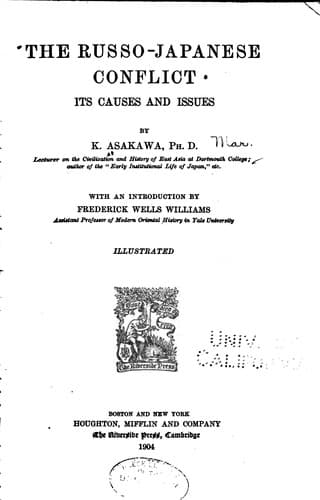
The Russo-Japanese Conflict: Its Causes and IssuesAsakawa, Kan'ichi
History
The Russo-Japanese Conflict: Its Causes and Issues
Asakawa, Kan'ichi
Russo-Japanese War, 1904-1905; Russo-Japanese War, 1904-1905 -- Causes
who was now supported by his British colleague, Mr. Jordan. The
bank-notes were not reinstated till February 13, 1903, when a compromise
was at last reached with the Korean Government.[539] It is impossible to
establish the complicity of the Russian diplomats in Yi Yong-ik’s
obstruction, which thus ended in failure, beyond the fact that the
Korean politician had been in close touch with the Muscovites. From the
historical point of view, Russia could hardly have interfered with the
issue of the Japanese bank-notes without transgressing the third Article
of the Nishi-Rosen Protocol of April 25, 1898.
Thus far we have related the comparative failure of Russia’s diplomacy
in South Korea and at the capital. In the north, however, which was
conterminous with her dominion and with Manchuria, Russia achieved a
greater success. On March 29, 1899,[540] M. Pavloff succeeded, after his
earlier and much larger demands had failed, in leasing for twelve years,
for the use of Count H. Keyserling, a Russian subject, three whaling
stations[541] on the northeastern coast, each 700 by 350 feet in extent.
This concession was offset by one secured by a Japanese citizen, on
February 14, 1900,[542] which conferred upon him the right of whaling
for three years, subject to renewal, along the Korean coast, excepting
the waters for the distance of three _li_ adjoining the three provinces
on which the Keyserling concessions were situated and the Province of
Chul-la.
Farther north, upon the frontier, the long boundary line naturally
divides itself into two parts, namely, the Tumên River, separating Korea
from Primorsk of Siberia and the Kirin Province of Manchuria, and the
Yalu River, which borders upon the strategically most important Province
of Sheng-king of South Manchuria. Along the former stream, Russia
acquired by a treaty of 1884[543] the opening of the port of Kiong-hung
to the Russian land trade, and a free navigation of the Tumên. A dozen
years later,[544] when the Sovereign sojourned at the Russian Legation,
the Muscovites concluded an agreement with the Seul Government whereby
they were granted the privilege of mining gold and other minerals for
fifteen years, and coal for twenty years, in two districts near
Kiong-hung, as well as the right to construct a railway or carriage-road
from the mines to the shore. It has often been reported that the
poverty-stricken people as well as the venal officers along the river
have continually mortgaged their property to the Russians, who thus have
acquired extensive tracts of land, circulated Russian coins among the
natives, and otherwise implanted their influence far and wide. Then
early in 1902, M. Pavloff sought to make a step in advance in this
direction, when, without permission from Korea, a telegraph line was
extended from Possiet to Kiong-hung across the Tumên River. He desired
that the Seul Government should recognize the accomplished fact, and
Rear Admiral Skrydloff, commanding the Pacific squadron of the Russian
Public-domain text, read in full here on John Shaqi.
Reviews
Reviews
No reviews yet
Be the first to share your thoughts on this work.
Elsewhere in the archive
Join the Discussion
Join the discussion
Sign in to leave a comment or review.
Sign InorCreate an account