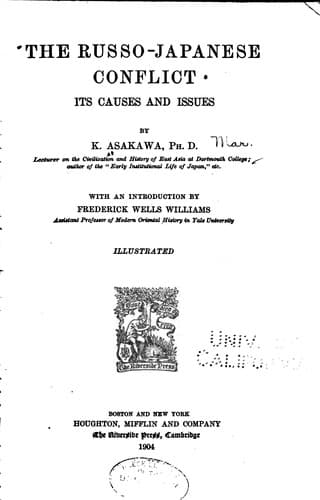
The Russo-Japanese Conflict: Its Causes and IssuesAsakawa, Kan'ichi
History
The Russo-Japanese Conflict: Its Causes and Issues
Asakawa, Kan'ichi
Russo-Japanese War, 1904-1905; Russo-Japanese War, 1904-1905 -- Causes
Stein, Russian _Chargé_
at Seul, suddenly notified the Korean Government, on April 13, 1903,
that Baron Gunzburg would henceforth represent at Seul the interest of
the timber syndicate, which would now commence its work upon the
Yalu.[565] Early in May, forty-seven Russian soldiers in civilian dress,
presently increased to sixty, besides a larger number of Chinese and
Koreans under Russian employ, were reported to have come to
Yong-am-po,[566] a point near the mouth of the river and rather remote
from the places[567] where actual cutting was in progress, and had begun
to construct what was claimed to be timber-warehouses, but later proved
to be, besides some godowns, a blacksmith plant and a six-foot
mound.[568] At the same time, there was taking place a mysterious
mobilization of troops from Liao-yang and Port Arthur towards
Fêng-hwang-Chêng and An-tung on the other side of the Yalu.[569] The
Korean frontier officers reported that a panic had been created among
the inhabitants, and that the Korean-Manchurian commerce had
stopped.[570] Presently, the Russian soldiers at Yong-am-po were
reported to have been increased, first by 100, and then by 200, who
purchased from the natives, under the name of a Korean citizen and
against the wishes of the local authorities, fifteen houses and some
twelve acres of land.[571] When the Korean Government had, on May 15,
demanded of M. Stein to order the evacuation of the Russians,[572] M.
Pavloff, who had recently returned from his trip to Russia, requested,
on the contrary, that the Korean Government should protect the Russian
subjects at Yong-am-po.[573] A desultory discussion then ensued between
M. Pavloff and the Korean Government, while further increases of the
Russian forces at An-tung beyond the river were reducing the frontier
regions generally into a state of anarchy.[574] About the middle of
June, the Russians forcibly seized rafts belonging to some Koreans and
Chinese that came down the stream, and shot two Chinese who
resisted.[575] A Japanese-Chinese syndicate, also, which had secured a
timber concession in this region in March from the Korean Government,
reported that its rafts had been seized, and its work had consequently
been suspended.[576] Prior to this, four Russian war-vessels under
command of Admiral Starck came to Chemulpo in the night of June 5,[577]
and stayed there till the 11th. No matter whether there was any
significance in this act, it is sufficient to record that it took place
at this critical moment. Not the least serious feature of the affair was
the disagreement of opinion about it inside the Korean Government. When,
on June 11, the Council of State passed a resolution that the conduct of
the Russians upon the frontier was contrary to the treaty arrangements
between the two Powers, the Foreign Office, on the 14th, sought to
refute the ground in an elaborate note.[578] The gravity of the
situation as evinced in all these facts need hardly be pointed out.
Public-domain text, read in full here on John Shaqi.
Reviews
Reviews
No reviews yet
Be the first to share your thoughts on this work.
Elsewhere in the archive
Join the Discussion
Join the discussion
Sign in to leave a comment or review.
Sign InorCreate an account