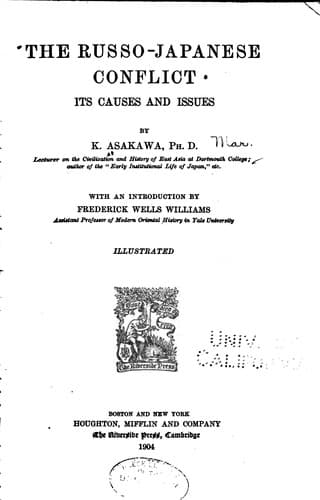
The Russo-Japanese Conflict: Its Causes and IssuesAsakawa, Kan'ichi
History
The Russo-Japanese Conflict: Its Causes and Issues
Asakawa, Kan'ichi
Russo-Japanese War, 1904-1905; Russo-Japanese War, 1904-1905 -- Causes
Whatever the intentions of the Russian Government or even of its
Representative at Seul, the action of the Muscovites at Yong-am-po was
precisely of a nature to remind one of their previous fortification of
Port Arthur, which had eventually prepared their entry into the whole of
Manchuria. The fact that the occupation of Yong-am-po took place
simultaneously with the suspension of the evacuation of Manchuria and
with the active military connection between its army centres and the
Korean frontier, gave the present affair an exceedingly ominous
appearance. And yet, in the face of these perilous circumstances, the
Korean Government showed itself so impotent and so little alive to the
situation as to be divided against itself on a minor point of the law of
the case. In such a state of things, the usual method of Japan to resist
Russia through Korea would be utterly futile.
It is unnecessary to recall that any attempt upon the integrity of Korea
was in violation of the fundamental principle which formed the first
Article of the Nishi-Rosen Protocol of April 25, 1898,[579] as well as
against the spirit of this and the two other Russo-Japanese agreements
regarding Korea. These agreements seemed to Japan to have in one way or
another been palpably violated by the Russians in many of their actions
in Korea, to which the Yong-am-po affair was a climax. Under
circumstances so continually irritating to the peace of the East and so
threatening to her own vital interests, the Government of Japan now felt
justified, when the climax was reached, in opening _direct_ negotiations
with Russia, in order to arrive at such a definite understanding of the
relative position of the Powers in Korea, as would insure the mutual
benefit of the three nations concerned.
-----
Footnote 516:
The sovereign of Korea, formerly King (_wang_), assumed the title
Emperor (_Hwang-ti_), on October 12, 1897, for, in the Chinese
language, the _wang_ may be a tributary prince, but the _ti_ is the
master of an independent state.
Footnote 517:
_Tokushu Jōyaku_, pp. 747–751. See also _The Times_, August 30, 1899.
Footnote 518:
The _Kokumin_, October 10, 1899.
Footnote 519:
_Tokushu Jōyaku_, pp. 751–752.
Footnote 520:
_Ibid._, pp. 752–753.
Footnote 521:
The _Kokumin_, April 1, and 3, 1900.
Footnote 522:
The _Kokumin_, May 25, 1900, and May 21, 1901.
Footnote 523:
_Tokushu Jōyaku_, p. 751.
Footnote 524:
The _Kokumin_, May 21 and November 1, 1901. The final agreement
between Hayashi and the Korean Foreign Minister was signed on May 17,
1902, and published in the _Kwampō_.
Footnote 525:
The _Kokumin_, March 20, 1901, and August 7, 1902.
Footnote 526:
_Ibid._, May 5 and 10, 1901.
Footnote 527:
The _Kokumin_, April 23, 24, May 3, June 9, 1901.
Footnote 528:
_Ibid._, May 18, 1901; January 19, February 1, correspondence dated
April 2, 1902.
Footnote 529:
_Ibid._, October 22, November 17, 1902.
Footnote 530:
Public-domain text, read in full here on John Shaqi.
Reviews
Reviews
No reviews yet
Be the first to share your thoughts on this work.
Elsewhere in the archive
Join the Discussion
Join the discussion
Sign in to leave a comment or review.
Sign InorCreate an account