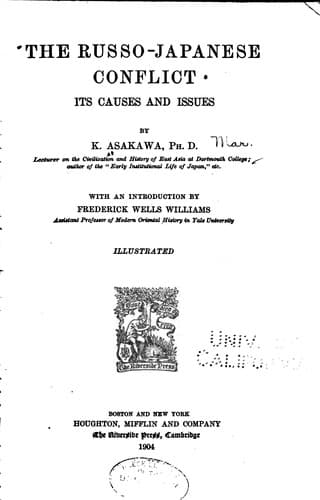
The Russo-Japanese Conflict: Its Causes and IssuesAsakawa, Kan'ichi
History
The Russo-Japanese Conflict: Its Causes and Issues
Asakawa, Kan'ichi
Russo-Japanese War, 1904-1905; Russo-Japanese War, 1904-1905 -- Causes
_Tokushu Jōyaku_, pp. 765–768. This contract includes certain
interesting provisions, which the reader may compare with those of the
Manchurian railways. There occur two exclusive measures, that none but
Koreans and Japanese may hold shares of the railway capital (Article
15), and that no other foreigners shall reside within lands assigned
for the depots (Article 5). The work should be begun within three
years after the signature of the contract, and be completed within ten
years hence (Article 10). After fifteen years of operation, the Korean
Government might purchase the entire line, and, if unable to do so,
the purchase would be postponed by periods of ten years (Article 12).
As soon as the Korean finances should admit, the railway might be made
a common work between the Koreans and Japanese (Article 13). The
laborers and the timber employed in the construction should as far as
possible be obtained in Korea (Article 6). The lands assigned for the
line and its depots shall belong to the company only so long as it
operates the road, and the Korean Government should furnish no other
lands to the company (Articles 3 and 8). It should be added that the
Japanese Government guaranteed a six per cent. interest for the
capital of the company.
For further details of the Seul-Chemulpo and Fusan-Seul Railways, see
p. 24, and notes, above.
Footnote 550:
For the contract, see _Tokushu Jōyaku_, pp. 770–772.
Footnote 551:
_Tokushu Jōyaku_, pp. 768–770; the _Kokumin_, September 7, 1901.
Footnote 552:
The _Kokumin_, July 4, 1902.
Footnote 553:
It is said that the Russian Representative obtained a promise from the
Korean Government to grant to no other foreigners the right of either
the construction or the mortgage of this railway.—The _Kokumin_,
December 10, 1903. It now matters little whether this report was true
or not, since the Korean Government abrogated on May 18, 1904, all the
agreements it had concluded with the Russians.
Footnote 554:
The _Kokumin_, February 18, 1903; the _Dōbun-kwai_, No. 41, pp. 91–93.
Footnote 555:
The _Kokumin_, August 4, 1903.
Footnote 556:
See, e. g., pp. 10–30.
Footnote 557:
_Tokushu Jōyaku_, pp. 781–791.
Footnote 558:
It is said that the time-limit was extended, on January 1, 1901, for
twenty years. See _Tokushu Jōyaku_, p. 783.
Footnote 559:
The company agreed to pay to the Korean Imperial House, through the
Russo-Chinese Bank, a royalty amounting to one fourth of the annual
profit. The company was to furnish all the capital, and was exempt
from all kinds of taxes and dues (Articles 10, 11, 14).
Footnote 560:
The _Kokumin_, correspondence, April 18, 1903; _Tokushu Jōyaku_, pp.
781–782.
Footnote 561:
Toward the end of May, 1903, simultaneously with their activity on the
Yalu, the Russian soldiers began again to cut trees at Mu-san.
Footnote 562:
Cf. Article 2 of the contract.
Footnote 563:
Public-domain text, read in full here on John Shaqi.
Reviews
Reviews
No reviews yet
Be the first to share your thoughts on this work.
Elsewhere in the archive
Join the Discussion
Join the discussion
Sign in to leave a comment or review.
Sign InorCreate an account