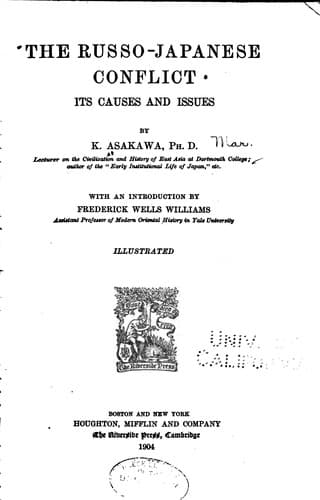
The Russo-Japanese Conflict: Its Causes and IssuesAsakawa, Kan'ichi
History
The Russo-Japanese Conflict: Its Causes and Issues
Asakawa, Kan'ichi
Russo-Japanese War, 1904-1905; Russo-Japanese War, 1904-1905 -- Causes
The _Kokumin_, correspondence, July 27, 1903. Lower down the stream,
at Tatung-kao, the amount sometimes reached the annual value of
7,000,000 _taels_.
Footnote 564:
See an address by Eitaro Tsuruoka, who has recently traveled in
Manchuria and is acquainted with several of the leaders of the
bandits. The _Dōbun-kwai_, No. 53 (April, 1904), pp. 1–14.
Footnote 565:
The _Kokumin_, April 23, 1903. The capital of the syndicate was
reported to be 5,000,000 rubles, of which 2,000,000 were said to have
been furnished by the Russian Government.—_Ibid._, correspondence,
June 19, 1903. This rumor was not authenticated. It is safe to say,
however, that Baron Gunzburg’s connection with the syndicate was
largely nominal. The present writer is not in a position to explain
the relation of the notorious M. Bezobrazoff to the timber work on the
Yalu.
Footnote 566:
The _Kokumin_, telegram, May 8 and 9, 1903.
Footnote 567:
Principally Mt. Paik-ma.
Footnote 568:
The _Kokumin_, telegram, June 11, correspondence, June 19, 1903. When
Japanese soldiers reached Yong-am-po soon after the beginning of the
present war, they found there a large warehouse, and fifteen large
brick and twenty or more smaller buildings. Rails had been laid
between the sea and the warehouse, which was also connected with the
Yalu by a new canal. A fort had also been left standing, but the guns
had been taken away.
Footnote 569:
_Ibid._, telegram, May 8 and 9, 1900. Cf. the _British Parliamentary
Papers: China, No. 2 (1904)_, Nos. 115, 116, 128, 129, 131, 134.
Footnote 570:
The _Kokumin_, telegram, May 9, 1903.
Footnote 571:
_Ibid._, telegram, May 22 and 25, 1903.
Footnote 572:
The _Kokumin_, telegram, May 16.
Footnote 573:
_Ibid._, correspondence, May 20.
Footnote 574:
_Ibid._, telegram, June 13.
Footnote 575:
_Ibid._, telegram, June 17.
Footnote 576:
_Ibid._, June 16.
Footnote 577:
_Ibid._, telegram, June 6.
Footnote 578:
The _Kokumin_, correspondence, June 19.
Footnote 579:
See p. 271, above.
CHAPTER XVIII
THE RUSSO-JAPANESE NEGOTIATIONS, I
It was in view of these dangerously unstable circumstances in Manchuria
and Korea that, on June 23, 1903, the four principal members of the
Japanese Cabinet[580] and five Privy Councilors[581] met before the
Throne, and decided on the principles upon which negotiations with
Russia should be opened.[582] Having thus formulated the policy to be
pursued, Baron Komura telegraphed to the Japanese Minister at St.
Petersburg, Mr. Kurino, on July 28, as follows[583]:—
[Illustration:
BARON KOMURA
_Japanese Foreign Minister_
]
“The Imperial Government [of Japan] have observed with close
attention the development of affairs in Manchuria, and its present
situation causes them to view it with grave concern.
Public-domain text, read in full here on John Shaqi.
Reviews
Reviews
No reviews yet
Be the first to share your thoughts on this work.
Elsewhere in the archive
Join the Discussion
Join the discussion
Sign in to leave a comment or review.
Sign InorCreate an account