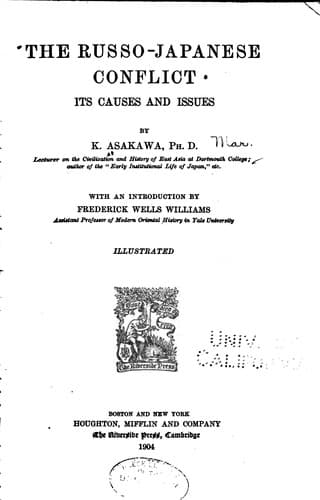
The Russo-Japanese Conflict: Its Causes and IssuesAsakawa, Kan'ichi
History
The Russo-Japanese Conflict: Its Causes and Issues
Asakawa, Kan'ichi
Russo-Japanese War, 1904-1905; Russo-Japanese War, 1904-1905 -- Causes
“So long as it was hoped that Russia would carry out, on the one
hand, the engagement that she made with China, and, on the other,
the assurances she had given to other Powers, regarding the subject
of the evacuation of Manchuria, the Imperial Government maintained
an attitude of watchful reserve. But the recent conduct of Russia
has been, at Peking, to propose new demands, and, in Manchuria, to
tighten her hold upon it, until the Imperial Government is led to
believe that Russia must have abandoned the intention of retiring
from Manchuria. At the same time, her increased activity upon the
Korean frontier is such as to raise doubts as to the limits of her
ambition.
“The unconditioned and permanent occupation of Manchuria by Russia
would create a state of things prejudicial to the security and
interest of Japan. The principle of equal opportunity would thereby
be annulled, and the territorial integrity of China impaired. There
is, however, a still more serious consideration for the Japanese
Government. That is to say, if Russia was established on the flank
of Korea, it would be a constant menace to the separate existence of
that Empire, or at least would make Russia the dominant Power in
Korea. Korea is an important outpost in Japan’s line of defense, and
Japan consequently considers her independence absolutely essential
to her own repose and safety. Moreover, the political as well as
commercial and industrial interests and influence which Japan
possesses in Korea are paramount over those of other Powers. These
interests and influence, Japan, having regard to her own security,
cannot consent to surrender to, or share with, another Power.
“The Imperial Government, after the most serious consideration, have
resolved to consult the Russian Government, in a spirit of
conciliation and frankness, with a view to the conclusion of an
understanding designed to compose questions which are at this time
the cause of their anxiety. In the estimation of the Imperial
Government, the moment is opportune for making the attempt to bring
about the desired adjustment, and it is believed that, failing this
opportunity, there would be no room for another understanding.
“The Imperial Government, reposing confidence in your judgment and
discretion, have decided to place the delicate negotiations in your
hands.
“It being the wish of the Imperial Government to place their present
invitation to the Russian Government entirely on an official
footing, you are accordingly instructed to open the question by
presenting to Count Lamsdorff, Minister of Foreign Affairs of
Russia, a _note verbale_ to the following effect:—
Public-domain text, read in full here on John Shaqi.
Reviews
Reviews
No reviews yet
Be the first to share your thoughts on this work.
Elsewhere in the archive
Join the Discussion
Join the discussion
Sign in to leave a comment or review.
Sign InorCreate an account