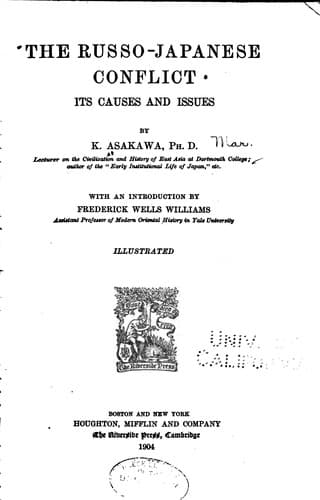
The Russo-Japanese Conflict: Its Causes and IssuesAsakawa, Kan'ichi
History
The Russo-Japanese Conflict: Its Causes and Issues
Asakawa, Kan'ichi
Russo-Japanese War, 1904-1905; Russo-Japanese War, 1904-1905 -- Causes
Thus the way was opened for an amicable interchange of the views of the
two Powers. This auspicious beginning of the negotiations stands in
striking contrast to their disastrous end. The discrepancy was perhaps
in no small measure due to a political situation at St. Petersburg which
was completely beyond the control of Count Lamsdorff, and probably also
of the Czar. It should be remembered that Baron Komura, like Marquis
Itō, was of the opinion that the conclusion of a satisfactory agreement
with Russia was not only desirable, but also possible. The same belief
was strongly shared by Mr. Kurino. It is also difficult to suppose that
Count Lamsdorff entered upon the negotiations with a deliberate
intention to introduce into them insurmountable difficulties, as he was
presently obliged to do, so as to bring them to a complete deadlock. On
the contrary, his remarks quoted in the preceding paragraph seem to
indicate that he and Mr. Kurino had frequently talked of the wisdom of
coming to a perfect adjustment of the interests of the two Powers in the
East, and that he was gratified that the opportunity was offered by the
Japanese Government to give effect to what he had long considered “the
best policy.” About this time, however, it had begun to be surmised
abroad that the peace party, with which the Count and M. Witte were said
to be in sympathy, had been largely overshadowed by the less intelligent
warlike faction. It was unknown what were the results of the
observations of General Kuropatkin, the then Minister of War, who had
made a tour of the East between the end of April and the end of July.
Nor was it possible to discover what took place in the great conference
held at Port Arthur early in July, in which the General, as well as
Admiral Alexieff, MM. Lessar, Pavloff, Rosen, and Pokotiloff, took part.
However that may be, it could hardly be denied that henceforth the
Eastern affairs passed under the sway of a less thoughtful body of men
at St. Petersburg, and of that executive officer of great talent, but
strategist and diplomat of unknown value, Admiral Alexieff, at Port
Arthur. M. Witte was relieved of his Ministry of Finance, and
transferred to the presidency of the council of ministers, which was
known to be of small real authority. On August 13, an Imperial _ukase_
was published in the Russian _Official Messenger_, stating that, “in
view of the complex problems of administration of the eastern confines
of the Empire, we [the Czar Nicolas] found it necessary to create a
power capable of assuring the peaceful development of the country and
satisfying urgent local needs.” For this purpose, a special vice-regency
called the Far East was created out of the Amur and Kwan-tung
territories, and Admiral Alexieff was appointed Viceroy of the Far East.
He was vested with supreme power in the civil administration of the
territories, with the command of the naval forces in the Pacific and of
Public-domain text, read in full here on John Shaqi.
Reviews
Reviews
No reviews yet
Be the first to share your thoughts on this work.
Elsewhere in the archive
Join the Discussion
Join the discussion
Sign in to leave a comment or review.
Sign InorCreate an account