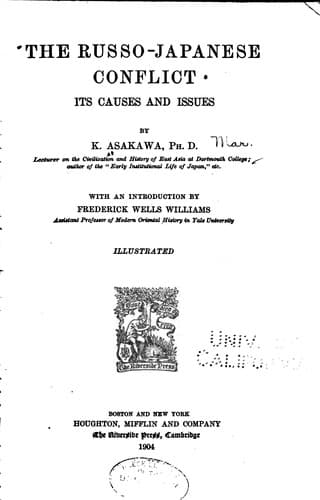
The Russo-Japanese Conflict: Its Causes and IssuesAsakawa, Kan'ichi
History
The Russo-Japanese Conflict: Its Causes and Issues
Asakawa, Kan'ichi
Russo-Japanese War, 1904-1905; Russo-Japanese War, 1904-1905 -- Causes
all the troops quartered in the country under his jurisdiction, and with
the management of the diplomatic relations of these regions with the
neighboring States. The Viceroy was released from the jurisdiction of
the Ministers at St. Petersburg, and the only control to be exercised
over him by the central power was through a special committee of
men[587] nominated by the Czar and presided over by himself.[588]
Statutes concerning this special committee of the Far East—which has in
itself no executive power—were promulgated on September 30.[589] When we
consider the probable state of Russian politics at the time, the
significance of thus elevating Alexieff and clothing him with enormous
powers could hardly be concealed. Henceforth the control of the Eastern
diplomacy of Russia seemed to have rested more with the Viceroy at Port
Arthur than with the Foreign Minister at St. Petersburg.[590]
Admiral Alexieff was appointed Viceroy on August 13. On the preceding
day,[591] the first Japanese note was handed to Count Lamsdorff by Mr.
Kurino, who had held it for about a week pending the Czar’s assent to
Japan’s proposition of July 28, already quoted. In this note, delivered
on August 12, Baron Komura wrote as follows:—
[Illustration:
ADMIRAL ALEXIEFF
_Viceroy of the Far East_
]
“In reference to my telegram of the 28th July, the Imperial
Government, after giving most serious consideration to the condition
of affairs in those regions where the interests of the two Powers
meet, have decided to propose the following articles as the basis of
an understanding between Japan and Russia:—
“1. ‘A mutual engagement to respect the independence and territorial
integrity of the Chinese and Korean Empires, and to maintain the
principle of equal opportunity for the commerce and industry of all
nations in those countries.
“2. ‘A reciprocal recognition of Japan’s preponderating interests in
Korea and Russia’s special interests in railway enterprises in
Manchuria, and of the right of Japan to take in Korea, and of Russia
to take in Manchuria, such measures as may be necessary for the
protection of their respective interests as above defined, subject,
however, to the provisions of Article 1 of this Agreement.
“3. ‘A reciprocal undertaking on the part of Russia and Japan not to
impede the development of those industrial and commercial
activities, respectively, of Japan in Korea and of Russia in
Manchuria, which are not inconsistent with the stipulations of
Article 1 of this Agreement.
“‘An additional engagement on the part of Russia not to impede the
eventual extension of the Korean Railway into Southern Manchuria so
as to connect with the Eastern Chinese and Shan-hai-kwan-Niu-chwang
lines.
Public-domain text, read in full here on John Shaqi.
Reviews
Reviews
No reviews yet
Be the first to share your thoughts on this work.
Elsewhere in the archive
Join the Discussion
Join the discussion
Sign in to leave a comment or review.
Sign InorCreate an account