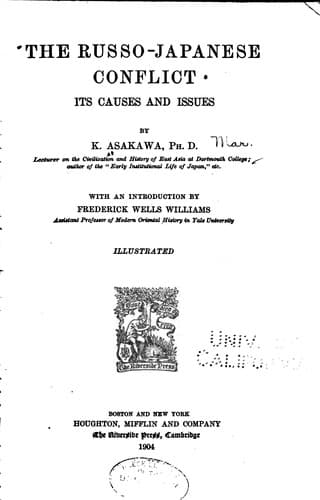
The Russo-Japanese Conflict: Its Causes and IssuesAsakawa, Kan'ichi
History
The Russo-Japanese Conflict: Its Causes and Issues
Asakawa, Kan'ichi
Russo-Japanese War, 1904-1905; Russo-Japanese War, 1904-1905 -- Causes
These articles are memorable, as their more essential features were
never altered in the later notes from Japan, as the persistent rejection
by Russia of the principles embodied in these articles inevitably ended
in hostilities, and, the most important of all, as much of the future of
the East would seem to depend upon whether these principles should win
or fail through the war. The principles were as obvious as the note was
“largely self-explanatory.” At their basis was the desire for a general,
lasting peace of the Far East, or, in other words, an effective
elimination of unnatural, irritating circumstances, so that the East may
develop its enormous material and moral resources, and thereby establish
with the West an intimate and mutually beneficial relationship. Upon
this fundamental desire were built two great principles, which had long
been the mottoes of Eastern diplomacy; namely, the territorial integrity
of, and the “open door” in, China and Korea. These principles, which
Russia had frequently avowed on her own initiative, Japan now requested
her to uphold mutually with herself. Side by side with these
considerations, the vested interests and the peculiar position,
respectively, of Russia in Manchuria and Japan in Korea, were to be
reciprocally recognized by the two Powers, in such a way, however, as
not to infringe the two great principles already named. Observe that the
Russian interests in Manchuria were not less respected than the Japanese
interests in Korea, nor was the Russian occupation of Manchuria more
guarded against than the Japanese annexation of Korea. The only ground
in the note for a possible misinterpretation was the Article which
provided for Japan’s sole right to advise and aid Korea for the cause of
the good government and reform of the latter. Experience had shown that
the independence and progress of Korea, upon which one half of Japan’s
own future rested, would be possible only by the internal reform and
development of the Peninsular Empire, and that, unfortunately, the task
of reform could not safely be left either with the indolent Korea or
with another Power, be it China or Russia, whose ultimate object would
be best served were Korea to remain feeble. The reform of Korea may
truly be called the penalty of Japan’s geographical position, and the
latter’s success in the fulfillment of this most delicate mission must
depend on her sense of just proportion and utmost self-control. And
nothing seems to kindle the Japanese nation with a higher ambition than
their profound determination to perform what they deem their historic
mission in the fairest spirit of human progress. Only along these lines,
moreover, by a peculiar coincidence of circumstances, the securest
interests of Japan as a nation seem to lie. For it appears to be her
singular fortune that her interests become every year more closely tied
with the best tried principles of progress. Upon fairness her life
Public-domain text, read in full here on John Shaqi.
Reviews
Reviews
No reviews yet
Be the first to share your thoughts on this work.
Elsewhere in the archive
Join the Discussion
Join the discussion
Sign in to leave a comment or review.
Sign InorCreate an account