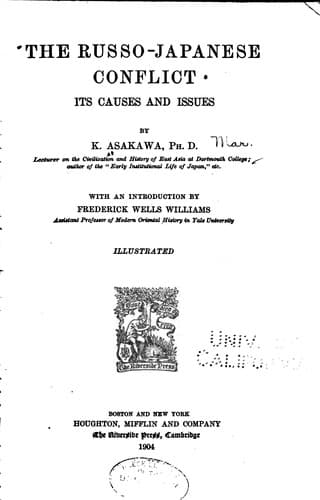
The Russo-Japanese Conflict: Its Causes and IssuesAsakawa, Kan'ichi
History
The Russo-Japanese Conflict: Its Causes and Issues
Asakawa, Kan'ichi
Russo-Japanese War, 1904-1905; Russo-Japanese War, 1904-1905 -- Causes
depends, and upon it the natural growth of the millions of the East
would seem to rest. It appeared, therefore, evident to the Japanese
statesmen that in no other manner than along the course suggested by
their propositions to Russia could the welfare of all the interested
parties be assured, and the future repose and progress of the East
guaranteed. On the other hand, however, nothing could be more
distasteful to the party presumably in control of the Eastern policy of
Russia at the time than the reciprocal understanding proposed by Mr.
Kurino in his note of August 12.
Before replying to this note, Count Lamsdorff suddenly demanded, on
August 23, that negotiations should be conducted at Tokio instead of at
St. Petersburg, as had been desired by Japan[594]. This move of Russia
was closely parallel to the policy she once pursued in China regarding
the lease of Port Arthur, when she declined to negotiate at the Russian
Capital[595]. A discussion at St. Petersburg might save it from many of
the vexatious delays which would naturally attend its being held at an
Eastern capital, away from the Foreign Office of the Power whose
interest counseled procrastination. Of the several reasons presented by
Russia for her proposition, one was that the local knowledge of Viceroy
Alexieff had constantly to be consulted. Japan pointed out that the
proposed Agreement concerned matters of principle, and not of local
detail[596]. Her repeated request, however, to negotiate at St.
Petersburg was firmly refused by Russia, as was also Japan’s suggestion
that her note be made the basis of the discussion.[597] Negotiations
were therefore transferred to Tokio, and the Japanese note and the
Russian counter-note—the latter not then received—were together to serve
as the base of the _pourparlers_[598]. This question, which marked the
beginning of many long delays to follow, itself consumed two weeks
before any real progress of the negotiations could be made.
After a delay of nearly eight weeks, Russia, on October 3, sent her
counter-note, which, as will be seen from the following telegram of the
5th, from Baron Komura to Mr. Kurino, revealed the utter
irreconcilability of the wishes of the two Powers:—
“Baron Rosen [Russian Minister at Tokio] came back from Port Arthur
on the 3d instant. He called on me the same day, and handed me the
following as the Russian counter-proposals, which, he said, had been
sanctioned by His Majesty the Emperor of Russia, upon the joint
representations of Admiral Alexieff and himself:—
“1. ‘Mutual engagement to respect the independence and territorial
integrity of the Korean Empire.
“2. ‘Recognition by Russia of Japan’s preponderating interests in
Korea, and of the right of Japan to give advice and assistance to
Korea tending to improve the civil administration of the Empire
without infringing the stipulations of Article 1.
Public-domain text, read in full here on John Shaqi.
Reviews
Reviews
No reviews yet
Be the first to share your thoughts on this work.
Elsewhere in the archive
Join the Discussion
Join the discussion
Sign in to leave a comment or review.
Sign InorCreate an account