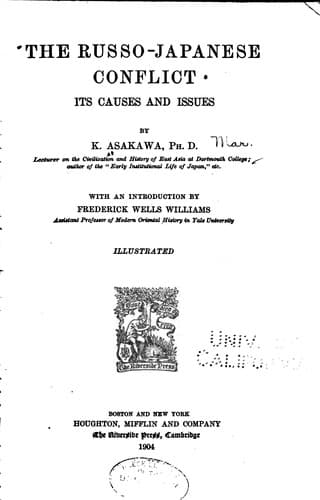
The Russo-Japanese Conflict: Its Causes and IssuesAsakawa, Kan'ichi
History
The Russo-Japanese Conflict: Its Causes and Issues
Asakawa, Kan'ichi
Russo-Japanese War, 1904-1905; Russo-Japanese War, 1904-1905 -- Causes
About 2¾ by 5¾ miles.—_Ibid._, November 1. Late in December, a report
reached the Korean Government from the frontier that the Russians had
forbidden all but their countrymen to enter into the Russian territory
at Yong-am-po.—_Ibid._, December 23.
Footnote 626:
Many stories have been told of M. Pavloff’s influence over the venal
politicians of Seul. Of these, two are given below, which are not
verifiable, but certainly interesting.
Yi Keun-thaik is said to have told the Emperor, late in December,
1903, that the following assurance had been given by the Russian
Representative: if the Korean refusal to open Wiju and Yong-am-po to
foreign trade should result in the mobilization of Japanese forces,
Russia would also dispatch troops against them; in 1894, Korea erred
when she relied on China, but Russia was not a China, and might
implicitly be relied upon.—The _Kokumin_, telegram, December 25.
One day, it is said, M. Pavloff remarked in the presence of the Korean
Emperor and his attendants: “The Koreans often rely upon Japan, or
else are afraid of her, but where in the world is Japan?” Then he
scanned a map through a pocket magnifier, and said: “Oh, I find a tiny
country called Japan in a corner of the Pacific Ocean. My Russian
Empire is the greatest country on the globe, spreading over two
continents. If Korea relies upon our Empire, she will be as safe as in
navigating a sea in a colossal vessel. Should Japan object to it, our
Russia would only have to do thus.” Here, placing a few matches on his
palm, he blew them off.—The _Kyōiku Jiron_.
Footnote 627:
In the latter half of 1900, for example.
Footnote 628:
Korean neutrality is said to have been telegraphed to the Korean
Representatives abroad through the French channel. It was not until
some time after the other Powers had received the declaration that it
reached Japan. Russia, it will be remembered, told the world that
Japan infringed the neutrality of Korea when the former’s warships had
an encounter with the “Variag” and “Korietz” at Chemulpo. See pp. 355
ff., below.
CHAPTER XIX
THE RUSSO-JAPANESE NEGOTIATIONS, II
The Russian counter-note having been received on October 3, Baron Komura
began to confer with Baron Rosen upon the basis of both the Japanese
note and the Russian reply.[629] Meanwhile, the Japanese statesmen again
held deliberations on the 10th and 24th of October,[630] and agreed upon
the “irreducible minimum,” which was accordingly communicated to the
Russian Minister on the 30th in the form of the following note:—
“1. Mutual engagement to respect the independence and territorial
integrity of the Chinese and Korean Empires.
Public-domain text, read in full here on John Shaqi.
Reviews
Reviews
No reviews yet
Be the first to share your thoughts on this work.
Elsewhere in the archive
Join the Discussion
Join the discussion
Sign in to leave a comment or review.
Sign InorCreate an account