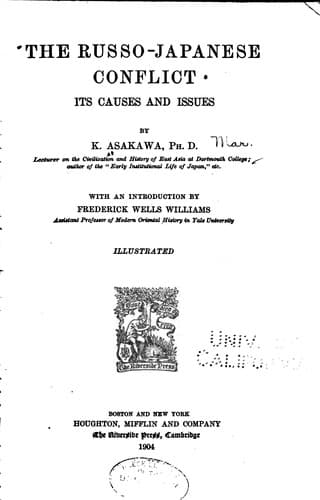
The Russo-Japanese Conflict: Its Causes and IssuesAsakawa, Kan'ichi
History
The Russo-Japanese Conflict: Its Causes and Issues
Asakawa, Kan'ichi
Russo-Japanese War, 1904-1905; Russo-Japanese War, 1904-1905 -- Causes
It is highly interesting that at this moment, when the Russian
Government was, on the one hand, negotiating with Japan, and, on the
other, proposing new demands upon China, the Russian Ambassador at
London intimated the desire of his Government to come to an agreement
with Great Britain regarding their interest in China. It appears that
Russia wished Great Britain to declare Manchuria as outside of her
sphere of interest, in return for a similar declaration by Russia
regarding the Yang-tsze valley. Lord Lansdowne’s reply was
characteristic. “I repeated,” he wrote to Sir C. Scott, “that we
should be glad to arrive at one [i. e., an agreement with Russia], but
that it must, of course, include the Manchurian question. We could,
however, of course not come to terms unless we were fully informed as
to the intentions of the Russian Government [in Manchuria]. Count
Benckendorff again asked me whether, if we were satisfied upon this
point, we should be likely to _assist_ in bringing about an
arrangement between the Russian and Chinese Governments. I said that
we should certainly make no secret of our concurrence, if we were
thoroughly satisfied. Meanwhile, however, I was afraid that our
attitude must remain observant and critical.”—_China, No. 2 (1904)_,
No. 142 (August 12). Cf. No. 139.
The Russian Government could not have forgotten that Great Britain had
agreed with Japan, on January 30, 1902, that neither of the two Powers
should come to a separate understanding with another Power regarding
China or Korea without a full and frank discussion between themselves.
Footnote 608:
_China, No. 2 (1904)_, Nos. 147, 148, 149, 156.
Footnote 609:
_China, No. 2 (1904)_, No. 150.
Footnote 610:
_Ibid._, Nos. 149, 151, 153, 160.
Footnote 611:
_Ibid._, Nos. 147 and 156.
Footnote 612:
_Ibid._, Nos. 150 and 160.
Footnote 613:
See pp. 252 ff., above.
Footnote 614:
_China, No. 2 (1904)_, No. 159.
Footnote 615:
See pp. 289 ff., above.
Footnote 616:
The _Kokumin_, Seul telegrams, July 6, 10, 17 (1903).
Footnote 617:
_Ibid._, July 23, 27; August 2, 8, 18.
Footnote 618:
_Ibid._, July 27, etc.
Footnote 619:
_Ibid._, August 12, 14, 23 (cf. July 17, etc.).
Footnote 620:
The _Kokumin_, August 10, September 2, etc.
Footnote 621:
The opening of Wiju was once granted by the Foreign Office, but the
Emperor refused to sanction it.—_Ibid._, November 21. This is another
illustration of the peculiar circumstances at Seul, that there exist
two political centres, the Government and the Court. (The opening of
neither Wiju nor Yong-am-po had been effected before the outbreak of
the present war.)
Footnote 622:
The _Kokumin_, August 29.
Footnote 623:
_Ibid._, August 27, 29.
Footnote 624:
_Ibid._, September 29.
Footnote 625:
Public-domain text, read in full here on John Shaqi.
Reviews
Reviews
No reviews yet
Be the first to share your thoughts on this work.
Elsewhere in the archive
Join the Discussion
Join the discussion
Sign in to leave a comment or review.
Sign InorCreate an account