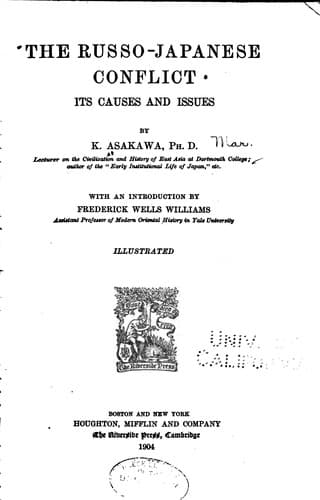
The Russo-Japanese Conflict: Its Causes and IssuesAsakawa, Kan'ichi
History
The Russo-Japanese Conflict: Its Causes and Issues
Asakawa, Kan'ichi
Russo-Japanese War, 1904-1905; Russo-Japanese War, 1904-1905 -- Causes
It will be seen from this note that Japan made several important
concessions. These naturally fall under three classes: concessions made
to an expressed wish of Russia; those in which desires of Russia were
changed from a one-sided into a reciprocal form; and those made
voluntarily on the part of Japan. To the first class belongs the free
passage of the Korean Straits (Article 5), while the neutralization of
territory on both sides of the northern frontier (Article 6), and the
mutual declaration that Korea was beyond the sphere of the “special”
interests of Russia, and Manchuria of Japan (Article 7), may be said to
fall under the second class. Purely voluntary concessions may be said to
consist of the tenth Article regarding the Eastern Chinese and Korean
Railways meeting on the Yalu, and a part of the eighth Article, in which
the “special” interests—not necessarily in the railway work alone, as in
the first Japanese note—of Russia in Manchuria were unequivocally
recognized. Other Articles are largely identical with those of the first
note, except the new ninth Article, which embodied the matter-of-fact
principle that the treaty rights of Russia in Korea, and of Japan in
Manchuria, should be mutually respected. Taken as a whole—with the only
exception regarding the preponderating interests of Japan in Korea, and
the natural wishes of Japan arising from this peculiar situation, the
former of which had been wholly,[632] and the latter partially,[633]
recognized by Russia—the prevailing characteristic of the second
Japanese note may be said to be its reciprocal nature. The special
interests of Russia[634] in Manchuria counterbalanced the preponderant
interests of Japan in Korea,[635] and each other’s right to take
necessary measures to protect those interests was recognized.[636] At
the same time, Manchuria was declared as far beyond the sphere of
Japanese special interests as was Korea of the Russian,[637] while, on
the other hand, the treaty rights of Russia in Korea, and of Japan in
Manchuria, were to be respected as a matter of course.[638] If Russia
was requested not to impede the economic activity of the Japanese in
Korea,[639] Japan also agreed not to fortify the Korean coast.[640] The
case of the neutral zone[641] need not be repeated. In spite, however,
of the reciprocal nature of the note, it is unnecessary to say, so long
as the control of the Eastern policy of Russia remained in the same
hands as before, she could hardly be expected to acquiesce in the
Japanese proposals.[642]
Public-domain text, read in full here on John Shaqi.
Reviews
Reviews
No reviews yet
Be the first to share your thoughts on this work.
Elsewhere in the archive
Join the Discussion
Join the discussion
Sign in to leave a comment or review.
Sign InorCreate an account