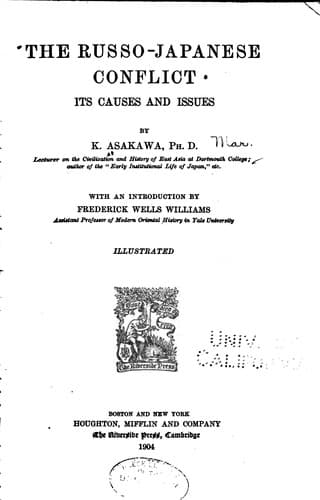
The Russo-Japanese Conflict: Its Causes and IssuesAsakawa, Kan'ichi
History
The Russo-Japanese Conflict: Its Causes and Issues
Asakawa, Kan'ichi
Russo-Japanese War, 1904-1905; Russo-Japanese War, 1904-1905 -- Causes
As has been said, the second note was handed by Baron Komura to Baron
Rosen on October 30. To this note, after a repeated application from
Japan for a speedy answer,[643] Russia replied only on December 11, or
more than forty days after the receipt of the Japanese note. This second
reply of Russia[644] was as much a reduction of her former concessions
as was the second note of Japan an increase upon hers; for Russia was
now entirely silent on the subject of Manchuria, and, regarding Korea,
repeated the restrictions proposed in September, as if the second
Japanese note had never reached her, besides refusing to recognize
Japan’s right to give Korea anything beyond mere advice for the reform
of her civil administration. In short, the second counter-note was
equivalent to the first _minus_ the clauses regarding Manchuria and
Japan’s right to assist Korea in the latter’s reform. The possibility of
a reconciliation of the views of the two Powers now appeared remoter
than before. If the exact contents of the reply had been publicly shown
to the Japanese people, it would have been extremely difficult for the
Katsura Cabinet to control their resentment against what would have been
regarded under the circumstances as a deliberate insult to their
country.
After another meeting of the Cabinet members and Councilors on the 16th,
Baron Komura made one more attempt to appeal to the friendly sentiment
of the Russian Government. The nature of the third Japanese overture
will be seen from the following dispatch, telegraphed by the Baron to
Mr. Kurino on the 21st:—
“In my interview with the Russian Minister on December 21, I pointed
out that, between our original proposals and the new Russian
counter-proposals, there was a fundamental difference concerning the
geographical sphere of the understanding. After fully explaining how
the Imperial Government had come to consider it desirable, in the
general interest, to include in the proposed understanding all the
regions in the Extreme East where the interests of the two Empires
met, I expressed the hope that the Russian Government would
reconsider their position regarding that branch of the question. I
also informed him, in detail, of the amendments which the Imperial
Government considered it necessary to introduce into Russia’s new
counter-proposals. Accordingly, in order to remove every possibility
of misunderstanding on the part of Russia respecting the attitude of
the Imperial Government, you are instructed to deliver to Count
Lamsdorff a _note verbale_ to the following effect:—
“‘The Imperial Government have examined with great care the new
Russian counter-proposals of the 11th instant. They regret that the
Russian Government did not agree to extend the compass of the
suggested understanding over the territory whose inclusion was
deemed essential by Japan.
Public-domain text, read in full here on John Shaqi.
Reviews
Reviews
No reviews yet
Be the first to share your thoughts on this work.
Elsewhere in the archive
Join the Discussion
Join the discussion
Sign in to leave a comment or review.
Sign InorCreate an account