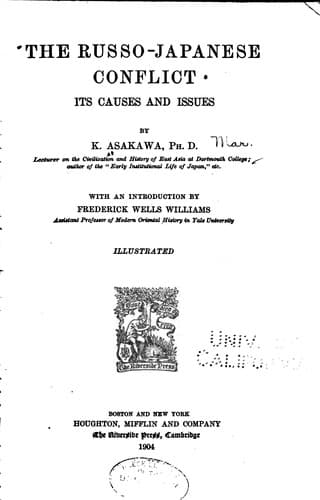
The Russo-Japanese Conflict: Its Causes and IssuesAsakawa, Kan'ichi
History
The Russo-Japanese Conflict: Its Causes and Issues
Asakawa, Kan'ichi
Russo-Japanese War, 1904-1905; Russo-Japanese War, 1904-1905 -- Causes
To return to the Russo-Japanese negotiations. Thus far notes and
replies, exchanged three times within a period of five months, must have
made the position of each negotiating Power perfectly clear to the
other. No further discussion could possibly bring the two Governments
nearer to a reconciliation of wishes so diametrically opposed. In the
mean time, the Japanese people were suffering from enormous economic
losses. A large part of their raw materials had ceased to come, the
shipping and trade with Korea and Northern China had declined, the
fishing industry had been paralyzed, and, contrary to the tendency at
normal times, the banks had been embarrassed with an over-abundance of
funds.[656] On the other hand, Russia, while circulating the optimistic
views of her Emperor and Foreign Minister, had continued her sharp
diplomacy at Seul and Peking, and pushed on land and sea her vast
warlike preparations in the East.[657]
Even then the Japanese Government would not terminate its negotiations
with Russia, for it was well aware that upon the conduct of these
negotiations the peace of the East depended. If the principles proposed
by Japan were not accepted, the integrity of China would be threatened,
and the independence of Korea, as well as the vital interest of Japan,
would be profoundly endangered; thus the entire future of the Far East
would be plunged into unknown perils. Under these circumstances, it
seemed that Japan owed to the world as much of patience, as she owed to
herself of determination. The situation was gravely discussed by the
statesmen on the 11th, and before the Throne again on the 12th.[658] On
the next day, January 13, now for the fourth time, and against the
wishes of the majority of the people, the Government of Tokio reminded
Russia of the serious position in which the two Powers found themselves,
and begged her to reconsider the situation. Observe the following
telegram of the same date from Baron Komura to Mr. Kurino:—
“You are instructed to deliver to Count Lamsdorff the following
_note verbale_ in order to confirm to him the views I have
communicated to Baron Rosen on the 13th January:—
“‘The Imperial Government, with a view to arriving at a pacific
solution of the pending questions, and to firmly establishing for
all time the basis of good relations between the two Powers, as well
as to protect the rights and interests of Japan, have, from this
point of view, given most careful and serious consideration to the
reply of the Russian Government which was delivered by his
Excellency Baron Rosen on the 26th instant. They have finally come
to the conclusion that the following modifications are necessary, i.
e.:—
“1. ‘Suppression of the first clause of Article 5 of the Russian
counter-proposals (presented to the Japanese Government through
Baron Rosen on December 11), that is to say, not to use any part of
Korean territory for strategical purposes.
Public-domain text, read in full here on John Shaqi.
Reviews
Reviews
No reviews yet
Be the first to share your thoughts on this work.
Elsewhere in the archive
Join the Discussion
Join the discussion
Sign in to leave a comment or review.
Sign InorCreate an account