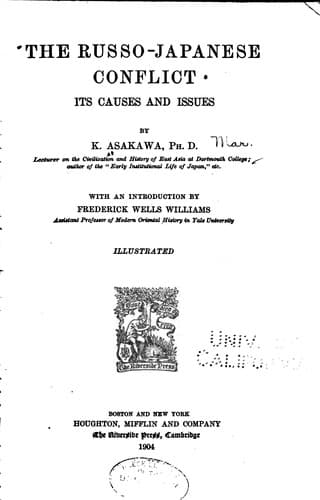
The Russo-Japanese Conflict: Its Causes and IssuesAsakawa, Kan'ichi
History
The Russo-Japanese Conflict: Its Causes and Issues
Asakawa, Kan'ichi
Russo-Japanese War, 1904-1905; Russo-Japanese War, 1904-1905 -- Causes
When Minister Kurino saw Count Lamsdorff on January 1, 1904, the latter,
as he had been persistently doing during the past few days, remarked
that he saw no reason why an _entente_ could not be arrived at, for
Minister Rosen would soon be instructed to proceed with the negotiations
in a friendly and conciliatory spirit.[648] Other statements of the same
pacific nature were frequently made, not only by the Count, but also by
the Czar, and were circulated through the press and foreign telegraphic
service. When, however, the reply of Russia[649] reached Tokio on
January 6, it was found that here again, as in the first reply of
September last, the recognition by Japan of Manchuria and its coast as
beyond her sphere of interest—the word “special” not preceding the last
word—was insisted upon, while, as before, no mention was made of the
territorial integrity of China in Manchuria. As regards the equal
opportunity for the enterprise of other nations, it should be noted that
Russia now agreed to insert a clause not to obstruct the enjoyment by
Japan and other Powers of the treaty rights which they had acquired from
China in regard to Manchuria, but only on the condition of maintaining
the clauses on the neutral zone in Korea and the non-employment by Japan
of any part of Korea for strategical purposes. Moreover, the treaty
rights of other Powers in Manchuria, which Russia would respect,
explicitly excluded those concerning the foreign settlements in the open
ports,[650] thus again evincing her exclusive policy. Over and above
these considerations, it should be remembered that, as has been pointed
out by Baron Komura,[651] the treaty rights which China had accorded to
other Powers could not be maintained if her sovereignty in Manchuria,
the existence of which Russia declined to assure Japan that she would
respect, should cease.[652]
In a few days there took place an important event which made the Russian
position untenable. The Chinese-American[653] and Chinese-Japanese[654]
commercial treaties which had been concluded on October 8, 1903,[655]
the date appointed for the final evacuation of Manchuria, were ratified
on January 11, 1904, the former opening to the world’s trade Mukden and
An-tung, and the latter, Mukden and Tatung-kao, thus not only
multiplying the treaty rights, including rights of foreign settlements,
of Japan and the United States in Manchuria, but also forcibly
reinstating the sovereign rights of the Chinese Empire in the territory,
and directly reversing the exclusive claims of Russia therein. It will
be recalled that Russia had recently seized Mukden, and had been
strengthening her forces upon the Yalu, on which the other two new ports
were situated. The United States Government, immediately upon the
ratification of the treaty, appointed Consuls for the three new open
ports.
Public-domain text, read in full here on John Shaqi.
Reviews
Reviews
No reviews yet
Be the first to share your thoughts on this work.
Elsewhere in the archive
Join the Discussion
Join the discussion
Sign in to leave a comment or review.
Sign InorCreate an account