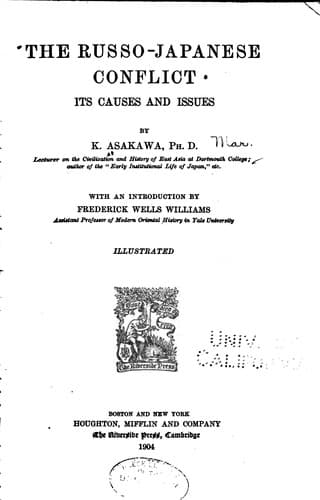
The Russo-Japanese Conflict: Its Causes and IssuesAsakawa, Kan'ichi
History
The Russo-Japanese Conflict: Its Causes and Issues
Asakawa, Kan'ichi
Russo-Japanese War, 1904-1905; Russo-Japanese War, 1904-1905 -- Causes
“As regards the increased land forces, Russia, beginning with the
two brigades of infantry, two battalions of artillery, and certain
numbers of cavalry and of the commissariat, which she sent to China
on June 29, 1903, under the pretext of making experiment of the
carrying capacity of the Siberian Railway, continually dispatched
troops to the Far East, until there were already, at the beginning
of February of this year, more than 40,000 soldiers. Russia was
further preparing to send, in case of necessity, over 200,000 more
soldiers.
“Simultaneously, Russia hastened her work through day and night in
building new forts at the naval harbors of Port Arthur and
Vladivostok; repaired fortifications at Kun-chun, Liao-yang, and
other strategic points; sent to the Far East by the volunteer fleet
and the Siberian Railway large quantities of arms and ammunition;
and, so early as the middle of October, 1903, fourteen trains
carrying field-hospital equipment left Russia in great haste. From
these data, one may conclude that Russia had not the least desire
for conciliation, but sought to coerce Japan by force of arms.
“The military activity of Russia was further accelerated from the
end of January. On the 21st of January, about two battalions of the
infantry and some of the artillery were sent from Port Arthur and
Talien to the northern frontier of Korea; on the 28th, Viceroy
Alexieff ordered the Russian troops near the Yalu to be placed on a
war footing; on February 1, the Governor of Vladivostok asked the
Japanese Commercial Agent at the port to prepare to withdraw to
Habarofsk the Japanese subjects residing there, as the Governor was,
under instructions from his Government, ready at any time to
proclaim martial law; all the capable warships at Port Arthur,
except one battleship under repair, steamed out to sea; and army
forces were continually leaving Liao-yang toward the Yalu. Who can
say that Russia had neither desire nor preparation for war? Under
these critical circumstances, rendering another day’s delay
inadmissible, Japan was compelled to break off the useless
negotiations and take necessary measures of self-protection. The
responsibility of provoking war does not rest upon Japan, but, on
the contrary, entirely upon Russia.
Public-domain text, read in full here on John Shaqi.
Reviews
Reviews
No reviews yet
Be the first to share your thoughts on this work.
Elsewhere in the archive
Join the Discussion
Join the discussion
Sign in to leave a comment or review.
Sign InorCreate an account