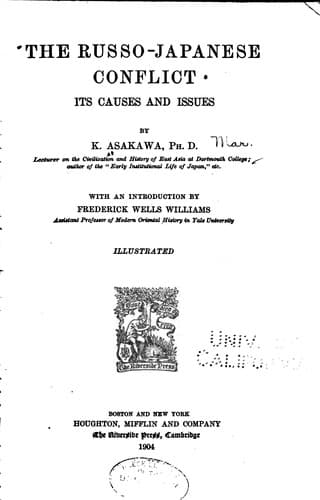
The Russo-Japanese Conflict: Its Causes and IssuesAsakawa, Kan'ichi
History
The Russo-Japanese Conflict: Its Causes and Issues
Asakawa, Kan'ichi
Russo-Japanese War, 1904-1905; Russo-Japanese War, 1904-1905 -- Causes
“Moreover, Japan notified Russia, on February 6, that she would
terminate her negotiations with Russia, and take such independent
action as she deemed best in order to defend her position menaced by
Russia and protect her interests, as well as that the diplomatic
relations with Russia were severed and the Japanese Legation would
withdraw from St. Petersburg. An independent action implies all,
including, as a matter of course, the opening of hostile acts. Even
if Russia were unable to understand it, Japan had no reason to hold
herself responsible for the misunderstandings of Russia. The
students of the international law all agree that a declaration of
war is not a necessary condition for beginning hostilities, and it
has been customary in modern warfare for the declaration to follow
the opening of the war. The action of Japan had, therefore, no
ground for censure in international law. It is singular that the
censure should come, as it did, from Russia, for historical
instances are not few in which she opened hostile acts without
declaring war. In 1808, she moved troops to Finland even before
diplomatic relations were severed.”[675]
* * * * *
By far the most important document containing Russian charges against
Japan was the following circular addressed by Count Lamsdorff, on
February 11, to the Russian Representatives abroad:—
“Since the rupture of the negotiations between Russia and Japan, the
attitude of the Tokio Cabinet has constituted an open violation of
all customary laws governing the mutual relations of civilized
nations.
“Without specifying each particular violation of these laws on the
part of Japan, the Imperial Government considers it necessary to
draw the most serious attention of the Powers to the acts of
violence committed by the Japanese Government with respect to Korea.
“The independence and integrity of Korea, as a fully independent
Empire, have been fully recognized by all the Powers, and the
inviolability of this fundamental principle was confirmed by Article
1 of the Shimonoseki treaty, and by the agreement especially
concluded for this purpose between Japan and Great Britain on
January 30, 1902, as well as by the Franco-Russian declaration of
March 16, 1902.
“The Emperor of Korea, foreseeing the danger of a possible conflict
between Russia and Japan, addressed, early in January, 1904, a note
to all the Powers, declaring his determination to preserve the
strictest neutrality. This declaration was received with
satisfaction by the Powers, and it was ratified by Russia. According
to the Russian Minister to Korea, the British Government, which had
signed the above-mentioned treaty with Japan on January 30, 1902,
charged the British diplomatic Representative at Seul to present an
official note to the Emperor of Korea, thanking him for his
declaration of neutrality.[676]
Public-domain text, read in full here on John Shaqi.
Reviews
Reviews
No reviews yet
Be the first to share your thoughts on this work.
Elsewhere in the archive
Join the Discussion
Join the discussion
Sign in to leave a comment or review.
Sign InorCreate an account