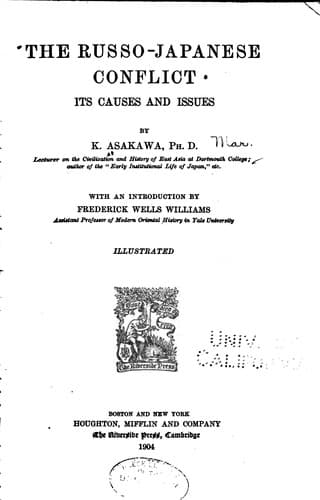
The Russo-Japanese Conflict: Its Causes and IssuesAsakawa, Kan'ichi
History
The Russo-Japanese Conflict: Its Causes and Issues
Asakawa, Kan'ichi
Russo-Japanese War, 1904-1905; Russo-Japanese War, 1904-1905 -- Causes
“The Imperial Government do not find it necessary in the present
instance to concern themselves in any way with views, opinions, or
declarations of the Russian Government, but they believe it to be
their right and duty to correct misstatements of facts which, if
permitted to remain uncontradicted, might give rise in the opinion
of neutral Powers to incorrect inferences and conclusions.
“Accordingly, the Imperial Government desire to make the following
statement respecting the five acts which are declared, in the
Russian note above referred to, to be fully proved and confirmed
facts:—
“1. The Imperial Government admit that a number of Japanese troops
landed in Korea before the formal declaration of war was issued by
Japan, but they must say that such landing did not take place before
a state of war actually existed between Japan and Russia. The
maintenance of the independence and territorial integrity of Korea
is one of the objects of war, and, therefore, the dispatch of troops
to the menaced territory was a matter of right and necessity, which,
moreover, had the distinct consent of the Korean Government. The
Imperial Government, therefore, drew a sharp distinction between the
landing of the Japanese troops in Korea in the actual circumstances
of the case and the sending of large bodies of Russian troops to
Manchuria without the consent of China while peaceful negotiations
were still in progress.
“2. The Imperial Government declare that the Russian allegation that
they stopped the delivery of Russian telegrams by the Danish cable
and destroyed the Korean Government’s telegraphic communication is
wholly untrue. No such acts were done by the Imperial Government.
“Regarding the alleged sudden attack, on February 8 last, upon two
Russian men-of-war in the port of Chemulpo, it is only necessary to
say that a state of war then existed, and that, Korea having
consented to the landing of Japanese troops at Chemulpo, that harbor
had already ceased to be a neutral port, at least as between the
belligerents.
“3. The Imperial Government have established a Prize Court, with
full authority to pronounce finally on the question of the legality
of seizures of merchant vessels. Accordingly, they deem it
manifestly out of place to make any statement on their part
regarding the Russian assertion that they unlawfully captured as
prizes of war the Russian merchantmen which were in the ports of
Korea.
“4. The Russian Government allege that the Japanese Government
declared to the Emperor of Korea through their Minister at Seul that
Korea would henceforth be under Japanese administration, and warned
the Emperor that, in case of non-compliance, Japanese troops would
occupy the palace. The Imperial Government declare this charge to be
absolutely and wholly without foundation.
Public-domain text, read in full here on John Shaqi.
Reviews
Reviews
No reviews yet
Be the first to share your thoughts on this work.
Elsewhere in the archive
Join the Discussion
Join the discussion
Sign in to leave a comment or review.
Sign InorCreate an account