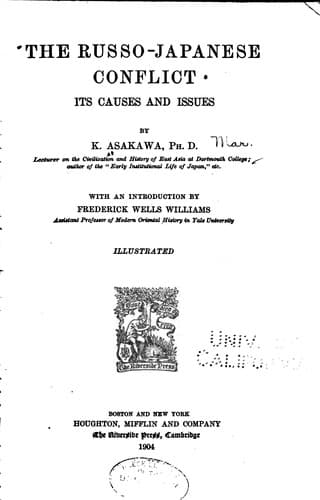
The Russo-Japanese Conflict: Its Causes and IssuesAsakawa, Kan'ichi
History
The Russo-Japanese Conflict: Its Causes and Issues
Asakawa, Kan'ichi
Russo-Japanese War, 1904-1905; Russo-Japanese War, 1904-1905 -- Causes
“5. No demand, either direct or indirect, was addressed by the
Japanese Government to the Russian Minister at Seul to retire from
Korea. The fact is as follows:—
“On February 10 last, the French _Chargé d’Affaires_ at Seul called
on the Japanese Minister there and informed him, as it was confirmed
afterwards in writing, that it was the desire of the Russian
Minister to leave Korea, and asked the opinion of the Japanese
Minister on the subject. The Japanese Minister replied that, if the
Russian Minister would withdraw in a peaceful manner, taking with
him his staff and the Legation guard, he would be fully protected by
Japanese troops. So he withdrew of his own free will on the 12th of
the same month, and an escort of Japanese soldiers was furnished for
him as far as Chemulpo.[678]
“The Russian allegation that the Japanese Government forwarded a
summons through the French Representative in Korea to the Russian
Minister to leave Korea is, therefore, not true. In this connection
it may be remarked that the Russian Consul at Fusan remained at his
post as late as until February 28 last. It is reported that he was
compelled to stay so long owing to the absence of instructions which
the Russian Minister apparently did not think of giving to the
Consul before his own departure from Seul. When it was known that
necessary instructions had at last reached the Russian Consul, and
that he desired to leave Fusan as soon as possible, the Japanese
Consul at the same port offered him every facility for the
departure, and his passage to Shanghai _via_ Japan was arranged by
the Japanese Consul.”[679]
In reply to the above, the Russian Government issued another statement
justifying its position, the purport of which may be gathered from the
following press dispatch:—
“ST. PETERSBURG, March 12—2:50 P. M. The following reply, inspired
by the Foreign Office, to Japan’s rejoinder to the Russian protest
against the violation of Korean neutrality may be accepted as
official:—
“Japan’s argument that she was justified in landing troops in Korea
before the declaration of war because she had Korea’s permission,
and also that these troops arrived in Korea after ‘the existence of
a state of war,’ is without value, as Korea in January promulgated
her neutrality to the Powers, which received it warmly, Great
Britain even officially conveying expressions of gratitude to the
Korean Government. Therefore, no state of war gave the Japanese the
right to violate her neutrality by landing troops in her territory.
Even the consent of Korea, though extorted by the Japanese, is
without force, from the fact that the dispatch of troops was not
only before the war, but before the breaking off of diplomatic
relations, as clearly established and indeed acknowledged by the
Japanese themselves.
Public-domain text, read in full here on John Shaqi.
Reviews
Reviews
No reviews yet
Be the first to share your thoughts on this work.
Elsewhere in the archive
Join the Discussion
Join the discussion
Sign in to leave a comment or review.
Sign InorCreate an account