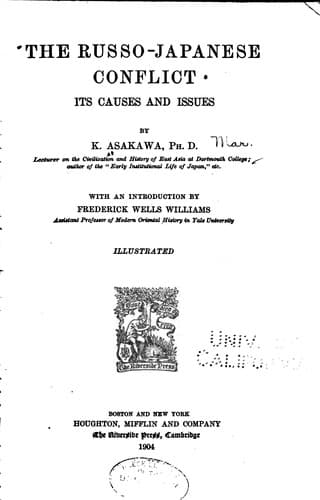
The Russo-Japanese Conflict: Its Causes and IssuesAsakawa, Kan'ichi
History
The Russo-Japanese Conflict: Its Causes and Issues
Asakawa, Kan'ichi
Russo-Japanese War, 1904-1905; Russo-Japanese War, 1904-1905 -- Causes
When Count Benckendorff, Russian Ambassador at London, handed the
memorandum on January 8 to Lord Lansdowne, the latter made
characteristically blunt remarks, as will be seen from the following
dispatch from him to Sir C. Scott: “... I could not help regretting
that Russia should have found it impossible to take even a single step
in pursuance of the policy which she has thus prescribed for herself
[regarding the evacuation of Manchuria]. I trusted that his Excellency
would forgive me for telling him frankly that, in this country, people
were looking for some concrete evidence of Russia’s intention to make
good her promises. An announcement, for example, that Niu-chwang was
to be evacuated at an early date would certainly have a reassuring
effect. So far as I was aware, there was no local difficulty in the
way.”—_China, No. 2 (1904)_, Nos. 162, 163.
Footnote 653:
The text is found in the _Monthly Summary of the Commerce and Finance
of the U. S._ for January, 1904.
Footnote 654:
In the press and the _Kwampō_ of January 20.
Footnote 655:
See pp. 252–254 and 317–318, above.
Footnote 656:
See the _Kwampō_ for February 1 (p. 5), 5 (pp. 110–114), 18 (p. 243),
20 (pp. 280–281); Mr. E. H. Vickers’s letter to the New York _Evening
Post_, March 1; Mr. Soyeda’s address, in the _Kokumin_, February 6;
_ibid._, on the fisheries.
Footnote 657:
According to the estimate of the Japanese Government, Russia increased
her forces in the Far East between April 8, 1903, and the outbreak of
the war, by 19 war-vessels aggregating 82,415 tons, and 40,000
soldiers, besides 200,000 more who were about to be sent. See pp.
352–354, below.
Footnote 658:
The Japanese dailies.
Footnote 659:
_N.-R._, No. 39.
Footnote 660:
_Ibid._, Nos. 40 (January 23), 42 (January 26), 44 (January 28), 46
(January 30). On January 26, Baron Komura again instructed Mr. Kurino
to remind Count Lamsdorff that “in the opinion of the Imperial
Japanese Government, a further prolongation of the present state of
things being calculated to accentuate the gravity of the situation, it
was their earnest hope that they would be honored with an early reply,
and that they wished to know at what time they might expect to receive
the reply.”—No. 42. The probable nature of the forthcoming reply was
also inquired into, without success, even so late as January 30.
Footnote 661:
No. 47. It is unnecessary to point out the various excuses Count
Lamsdorff presented for the delay. One of them was particularly
significant, that is, that the opinions of Viceroy Alexieff and of the
Cabinet Ministers at St. Petersburg had to be harmonized.—_Ibid._
Footnote 662:
Mr. Kurino telegraphed to Baron Komura at 5.05 A. M., February 5:—
Public-domain text, read in full here on John Shaqi.
Reviews
Reviews
No reviews yet
Be the first to share your thoughts on this work.
Elsewhere in the archive
Join the Discussion
Join the discussion
Sign in to leave a comment or review.
Sign InorCreate an account