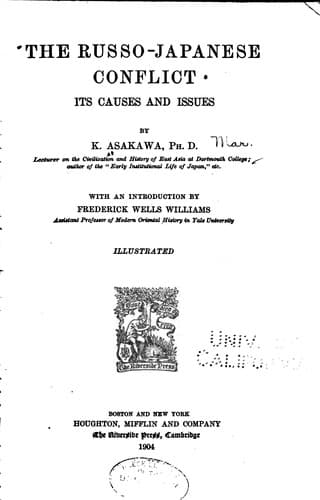
The Russo-Japanese Conflict: Its Causes and IssuesAsakawa, Kan'ichi
History
The Russo-Japanese Conflict: Its Causes and Issues
Asakawa, Kan'ichi
Russo-Japanese War, 1904-1905; Russo-Japanese War, 1904-1905 -- Causes
Footnote 648:
_Ibid._, No. 38.
Footnote 649:
The Russian counter-note was as follows:—
“Having no objection to the amendments to Article 2 of the Russian
counter-proposals as proposed by the Imperial Japanese Government, the
Russian Government considers it necessary:—
“1. To maintain the original wording of Article 5, which had already
been agreed to by the Imperial Japanese Government, that is to say,
‘mutual engagement not to use any part of the territory of Korea for
strategical purposes, not to undertake on the coasts of Korea any
military works capable of menacing the freedom of navigation in the
Korean Straits.’ [The Japanese Government had, as was pointed out by
Baron Komura in the dispatch No. 39, never agreed to the first half of
Article 5.]
“2. To maintain Article 6 concerning a neutral zone (this for the very
purpose which the Imperial Japanese Government has likewise in view,
that is to say, to eliminate everything that might lead to
misunderstanding in the future; a similar zone, for example, exists
between the Russian and British possessions in Central Asia).
“In case the above conditions are agreed to, the Russian Government
would be prepared to include in the projected agreement an article of
the following tenor:—
“‘Recognition by Japan of Manchuria and her littoral as being outside
her sphere of interests, whilst Russia, within the limits of that
province, will not impede Japan nor other Powers in the enjoyment of
the rights and privileges acquired by them under existing treaties
with China, exclusive of the establishment of settlements.’”—_N.-R._,
No. 38.
Footnote 650:
See _British Parliamentary Papers: China, No. 2 (1902)_, Nos. 133,
136, 139, 142.
Footnote 651:
His statements to the journalists on February 10 and at the Lower
House on February 23.
Footnote 652:
It is interesting to note that the Russian Representatives abroad
declared to the Powers about the same time as the third counter-note
was delivered at Tokio, that Russia “had no intention whatever of
placing any obstacle in the way of the continued enjoyment by foreign
Powers of the rights acquired by them [in Manchuria] in virtue of the
treaties now in force.” The exclusion of foreign settlements was not
mentioned, but, judging from the counter-note of January 6, was
implied.
Public-domain text, read in full here on John Shaqi.
Reviews
Reviews
No reviews yet
Be the first to share your thoughts on this work.
Elsewhere in the archive
Join the Discussion
Join the discussion
Sign in to leave a comment or review.
Sign InorCreate an account