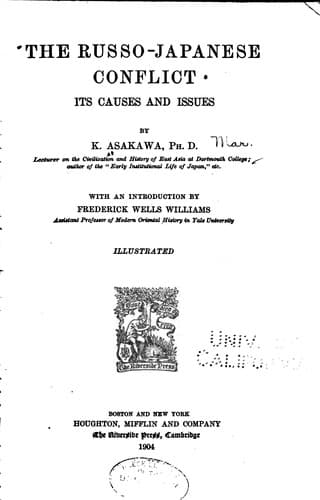
The Russo-Japanese Conflict: Its Causes and IssuesAsakawa, Kan'ichi
History
The Russo-Japanese Conflict: Its Causes and Issues
Asakawa, Kan'ichi
Russo-Japanese War, 1904-1905; Russo-Japanese War, 1904-1905 -- Causes
“The Imperial Government have carefully considered the question as
to what attitude China should assume to the best advantage, in case
Japan and Russia should go to war. The conflict between Japan and
Russia would affect the interests of China at least to the same
extent that it would those of Japan, and the Imperial Government
also fully recognize the advantage of utilizing for their aims the
resources of China, so immense in population and material. But, on
the other hand, they cannot overlook what effects would ensue should
China assume a hostile attitude [in favor of Japan]. Such an
attitude would probably plunge the finances of China into a still
greater confusion [than at present], and, if it did not incapacitate
her, it would render it difficult for her to meet her obligations.
Her foreign trade would also suffer unfortunate results. There,
however, exists an even greater apprehension, namely, that it is not
unlikely that thereby an anti-foreign feeling might again be aroused
in China, and the Powers of the world might be obliged to encounter
troubles similar to those of 1900. For these reasons, the Imperial
Government have advised the Chinese Government that, in case Japan
and Russia should go to war, they should observe neutrality, and
should take all possible measures to maintain order and peace within
their Empire.
“You are instructed to address a signed communication to this effect
to the Minister of Foreign Affairs of the Government to which you
are accredited, and also assure him that, if China maintains her
neutrality, and so long as Russia respects it, the Imperial
Government will likewise respect it.”[680]
Three days after this note was issued, the United States Minister at
Tokio, Mr. Griscom, delivered the circular note of Secretary Hay urging
on the belligerent Powers the advisability of respecting the neutrality
and maintaining the administrative entity of China, and of limiting the
zone of hostilities in the Chinese territory. The note, arriving as it
did, after the Japanese attitude had been clearly defined, Baron Komura
at once replied, on the 13th, that the Japanese Government were in
perfect accord with the United States Government in the desires
expressed by the latter, and would, so long as Russia made the same
pledge and faithfully observed it, promise to respect the neutrality and
the administrative entity of the Chinese Empire beyond regions actually
in Russian occupation. The result of the correspondence between the
United States and other Powers regarding Mr. Hay’s circular further
confirmed the views expressed in Japan’s reply, for the neutral rights
of China could hardly be enforced in Manchuria, or, in other words, the
zone of war would be best limited to that territory. These points were
agreed to by the Powers, including Germany, whose Emperor had
appealed[681] to the Government of Washington to take the initiative in
this general agreement.
Public-domain text, read in full here on John Shaqi.
Reviews
Reviews
No reviews yet
Be the first to share your thoughts on this work.
Elsewhere in the archive
Join the Discussion
Join the discussion
Sign in to leave a comment or review.
Sign InorCreate an account