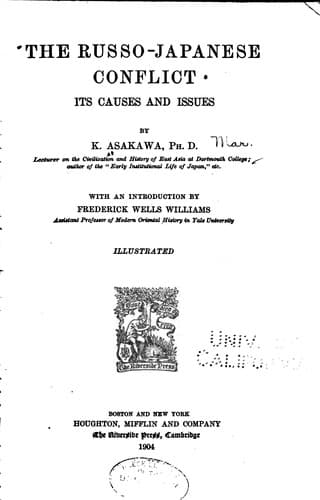
The Russo-Japanese Conflict: Its Causes and IssuesAsakawa, Kan'ichi
History
The Russo-Japanese Conflict: Its Causes and Issues
Asakawa, Kan'ichi
Russo-Japanese War, 1904-1905; Russo-Japanese War, 1904-1905 -- Causes
The Japanese note of February 9 and the general agreement of the Powers
secured by the United States thus confirmed each other, the former
establishing the principle of neutrality and the latter defining the
geographical limit of its application. The latter point, however,
involved a debatable problem, the solution of which was left to China
herself. It will be remembered that Japan, in her reply of February 13
to the United States, mentioned, as the field for hostile action, not
all Manchuria, but only the territory actually occupied by Russian
forces. This territory naturally excluded that portion of Manchuria
lying west of the Liao River which Russian troops evacuated before
October 8, 1902. The Chinese Government, in declaring the neutrality of
the Empire on the 13th, practically confirmed the construction of the
Japanese Foreign Office, for, in her declaration, China announced her
intention, which has since been carried out by Viceroy Yuan and General
Ma, of dispatching forces to the west of the Liao River from which the
Russian forces had withdrawn, in order to defend it against the
incursion of troops of either belligerent.[682]
All the essential points regarding China’s neutrality having been
settled to the satisfaction of Japan, the Government of the latter was
in a position to reply in the following manner, on February 17, to the
Chinese declaration of the 13th:—
“It being the desire of the Imperial Government to prevent
disturbance of peaceful conditions within the Chinese Empire, they
will, in all the Chinese dominion outside the territory under
Russian occupation, and so long as Russia acts likewise, respect the
neutrality of the Empire.... Japan’s hostilities against Russia
having been actuated, not by a desire for conquest, but solely by
the necessity of defending her just rights and interests, the
Imperial Government have not the slightest intention of acquiring
territory, as a result of the war, at the expense of China. It is
also desired that the Chinese Government will clearly understand
that the [warlike] measures to be taken [by Japan] in the field of
action within the Chinese territory, arising, as they will, purely
from military necessities, will not be of a nature to infringe the
sovereign rights of the Chinese Empire....”[683]
* * * * *
Ten days after Japan disavowed aggressive intentions in Manchuria, on
February 27, was published the new Korean-Japanese Protocol,[684]
concluded on the 23d, whereby Japan pledged herself to guarantee for all
time the independence and the territorial integrity of the Korean
Empire. The text of this remarkable document, in its English
translation, is as follows:—
Public-domain text, read in full here on John Shaqi.
Reviews
Reviews
No reviews yet
Be the first to share your thoughts on this work.
Elsewhere in the archive
Join the Discussion
Join the discussion
Sign in to leave a comment or review.
Sign InorCreate an account