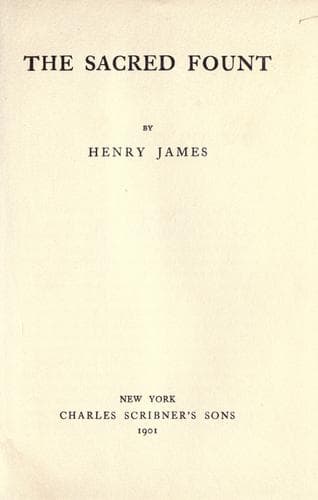
Man-woman relationships -- England -- Fiction; Married people -- England -- Fiction; Psychological fiction
I felt that if I insisted I should really stir up the old Long, the
stolid coxcomb, capable of rudeness, with whose redemption,
reabsorption, supersession--one scarcely knew what to call it--I had
been so happily impressed. "Oh, of course, if you haven't noticed, you
haven't, and the matter I was going to speak of will have no point. You
won't know what I mean." With which I paused long enough to let his
curiosity operate if his denial had been sincere. But it hadn't. His
curiosity never operated. He only exclaimed, more indulgently, that he
didn't know what I was talking about; and I recognised after a little
that if I had made him, without intention, uncomfortable, this was
exactly a proof of his being what Mrs. Briss, at the station, had called
cleverer, and what I had so much remarked while, in the garden before
dinner, he held our small company. Nobody, nothing could, in the time of
his inanity, have made him turn a hair. It was the mark of his
aggrandisement. But I spared him--so far as was consistent with my wish
for absolute certainty; changed the subject, spoke of other things, took
pains to sound disconnectedly, and only after reference to several of
the other ladies, the name over which we had just felt friction. "Mrs.
Brissenden's quite fabulous."
He appeared to have strayed, in our interval, far. "'Fabulous'?"
"Why, for the figure that, by candle-light and in cloth-of-silver and
diamonds, she is still able to make."
"Oh dear, yes!" He showed as relieved to be able to see what I meant.
"She has grown so very much less plain."
But that wasn't at all what I meant. "Ah," I said, "you put it the
other way at Paddington--which was much more the right one."
He had quite forgotten. "How then did I put it?"
As he had done before, I got rid of my ash. "She hasn't grown very much
less plain. She has only grown very much less old."
"Ah, well," he laughed, but as if his interest had quickly dropped,
"youth is--comparatively speaking--beauty."
"Oh, not always. Look at poor Briss himself."
"Well, if you like better, beauty is youth."
"Not always, either," I returned. "Certainly only when it _is_ beauty.
To see how little it may be either, look," I repeated, "at poor Briss."
"I thought you told me just now not to!" He rose at last in his
impatience.
"Well, at present you can."
I also got up, the other men at the same moment moved, and the subject
of our reference stood in view. This indeed was but briefly, for, as if
to examine a picture behind him, the personage in question suddenly
turned his back. Long, however, had had time to take him in and then to
decide. "I've looked. What then?"
"You don't see anything?"
"Nothing."
"Not what everyone else must?"
"No, confound you!"
Public-domain text, read in full here on John Shaqi.
Reviews
Reviews
No reviews yet
Be the first to share your thoughts on this work.
Join the Discussion
Join the discussion
Sign in to leave a comment or review.
Sign InorCreate an account