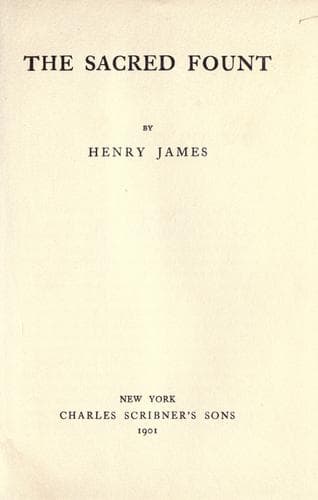
Man-woman relationships -- England -- Fiction; Married people -- England -- Fiction; Psychological fiction
Discretion, then, I finally felt, played an odd part when it simply left
one more attached, morally, to one's prey. What was most evident to me
by five o'clock in the afternoon was that I was too preoccupied not to
find it the best wisdom to accept my mood. It was all very well to run
away; there would be no effectual running away but to have my things
quickly packed and catch, if possible, a train for town. On the spot I
had to _be_ on it; and it began to dawn before me that there was
something quite other I possibly might do with Mrs. Server than
endeavour ineffectually to forget her. What was none of one's business
might change its name should importunity take the form of utility. In
resisted observation that was vivid thought, in inevitable thought that
was vivid observation, through a succession, in short, of phases in
which I shall not pretend to distinguish one of these elements from the
other, I found myself cherishing the fruit of the seed dropped equally
by Ford Obert and by Mrs. Briss. What was the matter with _me_?--so much
as that I had ended by asking myself; and the answer had come as an
unmistakable return of the anxiety produced in me by my first seeing
that I had fairly let Grace Brissenden loose. My original protest
against the flash of inspiration in which she had fixed responsibility
on Mrs. Server had been in fact, I now saw, but the scared presentiment
of something in store for myself. This scare, to express it sharply, had
verily not left me from that moment; and if I had been already then
anxious it was because I had felt myself foredoomed to be sure the poor
lady herself would be. Why I should have minded this, should have been
anxious at her anxiety and scared at her scare, was a question troubling
me too little on the spot for me to suffer it to trouble me, as a
painter of my state, in this place. It is sufficient that when so much
of the afternoon had waned as to bring signs of the service of tea in
the open air, I knew how far I was gone in pity for her. For I had at
last had to take in what my two interlocutors had given me. Their
impression, coinciding and, as one might say, disinterested, couldn't,
after a little, fail in some degree to impose itself. It had its value.
Mrs. Server _was_ "nervous."
Public-domain text, read in full here on John Shaqi.
Reviews
Reviews
No reviews yet
Be the first to share your thoughts on this work.
Join the Discussion
Join the discussion
Sign in to leave a comment or review.
Sign InorCreate an account