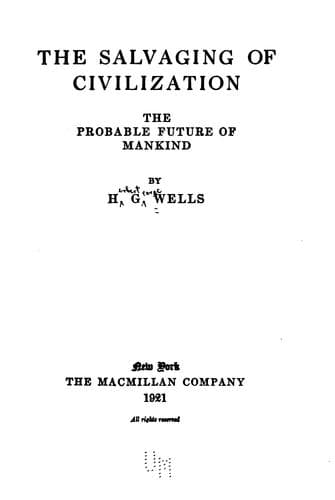
The Salvaging of CivilizationWells, H. G. (Herbert George)
Philosophy
The Salvaging of Civilization
Wells, H. G. (Herbert George)
Civilization, Modern -- 20th century; Education
I don't think we can, if we are to see it in terms of college buildings,
class rooms, tutors, professors and the like. Here again, just as in the
case of schooling, we have to raise the neglected problem--neglected so
far as education goes--of economy of effort; and we have to look once
more at the new facilities that our educational institutions have so
far refused to utilize. Our European colleges and universities have a
long and honourable tradition that again owes much to the educational
methods of the Roman Empire and the Hellenic world. This tradition was
already highly developed before the days of printing from movable type,
and long before the days when maps or illustrations were printed. The
higher education, therefore, was still, as it was in the Stone Age,
largely vocal. And the absence of paper and so forth, rendering
notebooks costly and rare, made a large amount of memorizing necessary.
For that reason the mediæval university teacher was always dividing his
subject into firstly and secondly and fourthly and sixthly and so on, so
that the student could afterwards tick off and reproduce the points on
his fingers--a sort of thumb and finger method of thought--still to be
found in perfection in the discourses of that eminent Catholic
apologist, Mr. Hilaire Belloc. It is a method that destroys all sense of
proportion between the headings; main considerations and secondary and
tertiary points get all catalogued off as equivalent numbers, but it was
a mnemonic necessity of those vanished days.
And they have by no means completely vanished. We still use the lecture
as the normal basis of instruction in our colleges, we still hear
discourses in the firstly, secondly and thirdly form, and we still
prefer even a second-rate professor on the spot to the printed word of
the ablest teacher at a distance. Most of us who have been through
college courses can recall the distress of hearing a dull and inadequate
view of a subject being laboriously unfolded in a long series of tedious
lectures, in spite of the existence of full and competent text-books.
And here again it would seem that the time has come to centralize our
best teaching, to create a new sort of wide teaching professor who will
teach not in one college but in many, and to direct the local professor
to the more suitable task of ensuring by a commentary, by organized
critical work, and so forth, that the text-book is duly read, discussed
and compared with the kindred books in the college library.
This means that the great teaching professors will not lecture, or that
they will lecture only to try over their treatment of a subject before
an intelligent audience as a prelude to publication. They may perhaps
visit the colleges under their influence, but their basis instrument of
instruction will be not a course of lectures but a book. They will carry
out the dictum of Carlyle that the modern university is a university of
books.
Public-domain text, read in full here on John Shaqi.
Reviews
Reviews
No reviews yet
Be the first to share your thoughts on this work.
Elsewhere in the archive
Join the Discussion
Join the discussion
Sign in to leave a comment or review.
Sign InorCreate an account