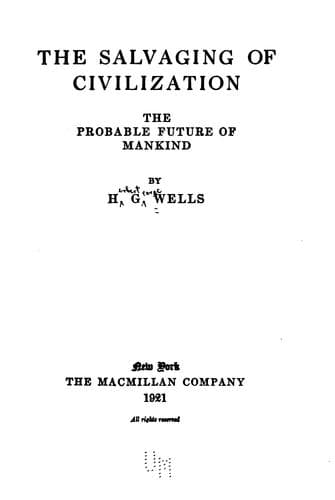
The Salvaging of CivilizationWells, H. G. (Herbert George)
Philosophy
The Salvaging of Civilization
Wells, H. G. (Herbert George)
Civilization, Modern -- 20th century; Education
By what we can only consider a series of fortunate accidents, the press
and the book world have provided and do provide a necessary organ in the
modern world state, an organ for swift general information upon matters
of fact and for the rapid promulgation and diffusion of ideas and
interpretations. The newspaper grew, as we know, out of the news-letter
which in a manuscript form existed before the Roman Empire; it owes its
later developments largely to the advertisement possibilities that came
with the expansion of the range of trading as the railways and suchlike
means of communication developed. Modern newspapers have been described,
not altogether inaptly, as sheets of advertisements with news and
discussions printed on the back. The extension of book reading from a
small class, chiefly of men, to the whole community has also been
largely a response to new facilities; though it owes something also to
the religious disputes of the last three centuries. The population of
Europe, one may say with a certain truth, first learnt to read the
Bible, and only afterwards to read books in general. A large proportion
of the book publishing in the English language in the seventeenth and
eighteenth centuries still consisted of sermons and controversial
theological works.
Both newspaper and book production began in a small way as the
enterprise of free individuals, without anyone realizing the dimensions
to which the thing would grow. Our modern press and book trade, in spite
of many efforts to centralize and control it, in spite of Defence of the
Realm Acts and the like, is still the production of an unorganized
multitude of persons. It is not centralized; it is not controlled. To
this fact the nexus of print owes what is still its most valuable
quality. Thoughts and ideas of the most varied and conflicting sort
arise and are developed and worked out and fought out in this nexus,
just as they do in a freely thinking vigorous mind.
I am not, you will note, saying that this freedom is perfect or that the
thought process of the print nexus could not go very much better than it
does, but I am saying that it has a very considerable freedom and vigour
and that so far as it has these qualities it is a very fine thing
indeed.
Now many people think that we are moving in the direction of world
socialism to-day. Collectivism is perhaps a better, more definite word
than socialism, and, so far as keeping the peace goes, and in matters of
transport and communication, trade, currency, elementary education, the
production and distribution of staples and the conservation of the
natural resources of the world go, I believe that the world and the
common sense of mankind move steadily towards a world collectivism. But
the more co-operation we have in our common interests, the more
necessary is it to guard very jealously the freedom of the mind, that is
to say, the liberty of discussion and suggestion.
Public-domain text, read in full here on John Shaqi.
Reviews
Reviews
No reviews yet
Be the first to share your thoughts on this work.
Elsewhere in the archive
Join the Discussion
Join the discussion
Sign in to leave a comment or review.
Sign InorCreate an account